Big Think

Body language expert: 7 cues that make you instantly more likable

Body language expert Vanessa Van Edwards shares her formula to create a lasting first impression.

A big myth about first impressions is that your first impression happens the moment you start talking.

5 literary classics that grapple with the void of nihilism

From mysterious villages to absurdism at the gallows, these books explore the origins, consequences, and possible responses to nihilism.
To access your creativity, start playing
Humans are naturally creative, but adulthood often teaches us to value productivity over play.

Rachael Renae

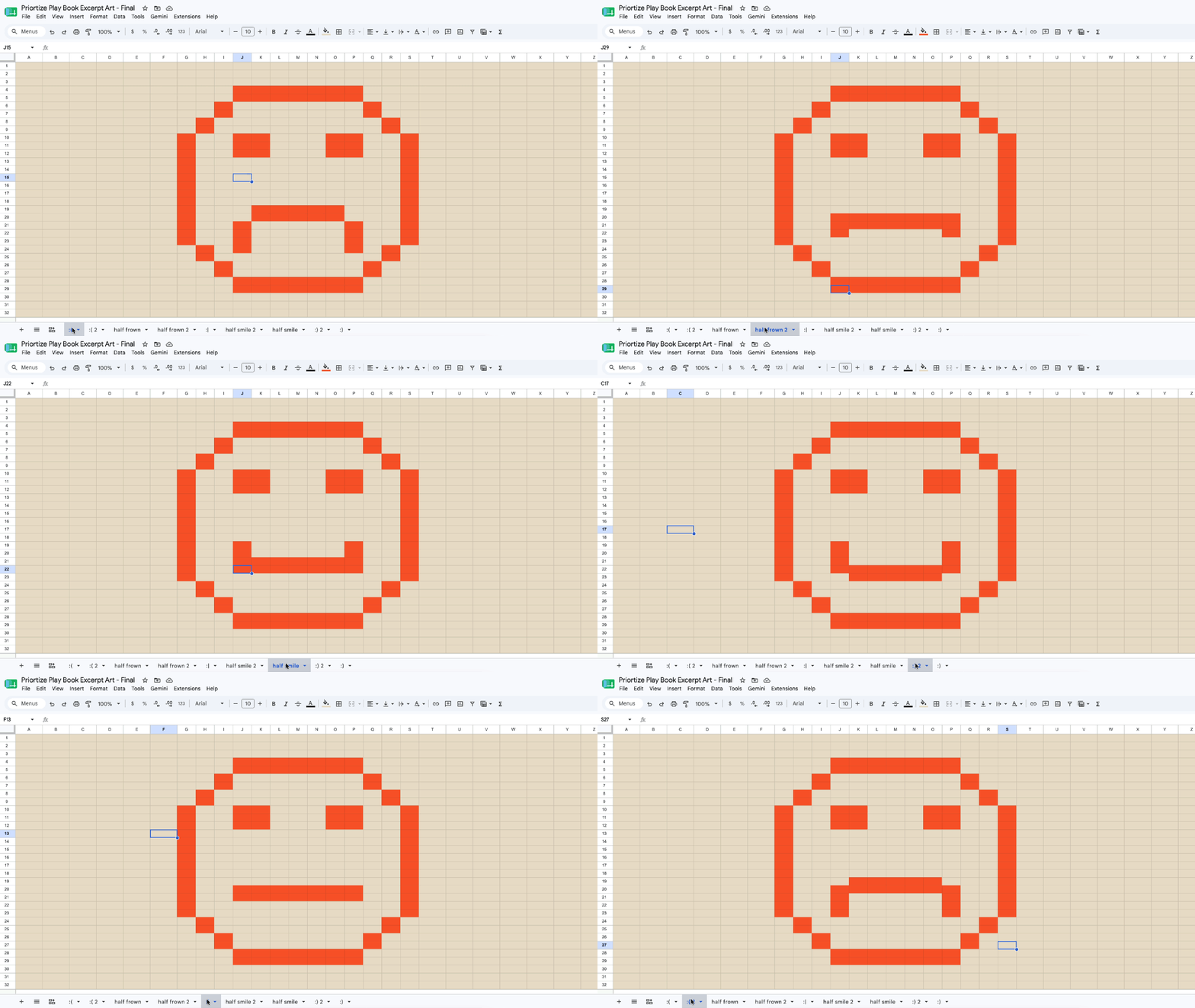
A spreadsheet with tan cells displays a pixelated red frowning face made by filling selected cells.
Black text on a light background reads "Explore our LIBRARY" with "Explore" in large font and "our LIBRARY" in smaller, uppercase font underneath.

What would you like to learn more about? We have thousands of videos from the world’s biggest thinkers to help you dive deeper into any subject.

Pause the busyness of life to reflect on ourselves, our relationships, and the Universe.
Intimate interviews with the world’s biggest thinkers.
A man wearing glasses and a navy blazer speaks while gesturing with his hands against a plain white background.
9mins
The trick that offloads intrusive thoughts so your brain can actually work
David Epstein, author of Range and Inside the Box, breaks down what's actually happening inside the brain when we multitask, and why "just focusing" is a solution that doesn't hold up to reality.
A man wearing glasses and a dark blazer gestures with his left hand while looking forward against a plain light background.
19mins
The unpopular truth about the myth of the lone genius
David Epstein argues that the myth of the lone genius is a story we tell, but the actual history of innovation is far more interesting.
A man with short blond hair and a beard wearing a black blazer over a maroon shirt sits against a plain light background, facing the camera.
21mins
The 6 triggers of aversion and how to defeat each one
In goal setting, Chris Bailey argues the problem isn't discipline; it's the system itself.
The Universe is out there, waiting for you to discover it.
A high-resolution image of the Eagle Nebula shows a bright star cluster, pink nebula clouds, and dark dust columns scattered throughout a star-filled background. Starts With A Bang podcast #130 – the initial mass function of stars
Contracting gas clouds don't just make a single star, but a spectrum, with all different masses. Early on, that spectrum differed. But why?
proton internal structure Ask Ethan: How did we discover substructure inside the proton?
Protons and neutrons are composite structures: made of quarks and gluons. But knowing they had substructure goes back long before that.
black hole central singularity Singularities inside black holes are truly unavoidable
Yes, "the laws of physics break down" at singularities. But relativity itself would have to be wrong for black holes to not possess them.
Image of a galaxy cluster with three marked regions labeled A, B, and C; the right side shows JWST zoomed-in views of red objects, hinting at possible black holes before galaxies—labeled QSO1A, QSO1B, and QSO1C. JWST proves that black holes really do come before galaxies
It's the Universe's ultimate chicken-and-egg question: what came first, the galaxy or the black hole? One Little Red Dot proves the answer.
Big ideas. Thoughtful conversations. One book at a time.
Book cover of "Socially Wired: How Culture Shapes Our Brains" by Matthew W. Schelke, featuring a colorful neural network illustration on a light background that highlights the connection between brain and meaning. The overlooked brain system shaping our motivations
Our motivations and sense of self may be more deeply shaped by our connections and social history than we think.
Book cover of "The Shortest History of Soccer" by Brian D. Bunk, featuring a green background, white and yellow text, and a soccer ball illustration at the bottom—perfect for those curious about the origin of soccer. Long before FIFA, these brutal folk games gave birth to soccer
Soccer emerged from chaotic folk games, elite school rivalries, and evolving rules that transformed a rough pastime into the beautiful game.
Book cover with a red background titled "Private Power and Democracy’s Decline: How to Make Capitalism Support Democracy" by Mordecai Kurz, exploring the complex relationship between private power and democracy's decline. When “survival of the fittest” justified monopolies and the slow death of democracy
America’s first Gilded Age reveals how concentrated economic power erodes democracy and offers a warning as similar forces reemerge today.
Book cover for "What Science Says About Astrology" by Carlos Orsi, featuring astrological symbols and geometric lines on a blue and black background, reflecting what science says about astrology. Astrology’s seductive nonsense — and why we still believe it
Vague predictions and post hoc revisions help astrology feel meaningful, even while it fails empirical testing.
Learn business from the world’s biggest thinkers.
Two scenes: Top shows climbers on an ice-covered terrain, embodying fun and success. Bottom captures an airplane in flight against a clear sky. Play it again: The causal link between fun and resilience
Fun in business is no laughing matter — it can create a golden strategic advantage and bring serious success in the long term.
Four workers assemble a large wooden tank using scaffolding and ladders at an outdoor construction site, with stacks of materials in the background. The 250-year-old company that survived by refusing to lay people off
What would your company do if it lost all its customers at once?
Book cover for "How Change Really Works" features multicolored lines radiating from a center, with one red line forming an arrow. The design reflects the dynamic process of transformation. Authors' names are displayed at the bottom. The 3 stories every leader needs to inspire successful transformations
Directives rarely inspire change. The most effective leaders use stories to make transformation memorable, resonant, and actionable.
A man stands in front of a collapsed wooden building with debris scattered around in an outdoor setting. How helping your rivals makes you harder to beat
A counterpoint to zero-sum thinking from Japan.
The world, seen sideways.
A color-coded map of the United States shows state-by-state data ranging from red (lower values) to green (higher values), with a scale from 102.6K to 133.0K. Follow the money: Mapping millionaire migration across America
Since 2018, around 103,000 millionaires moved out of California — and 133,000 millionaires moved in to Florida
Four maps of Ireland from 1800, 1850, 1900, and 2000 show a steady decline in areas where Irish is spoken natively, marked in green, nearly disappearing by 2000. The Irish language is having a moment — and running out of time
Gaeilge is trending culturally. So why is it, according to census data, also dying?
World map showing global oil reserves, rare earth elements deposits (yellow dots), and major shipping routes and chokepoints, with oil reserves highlighted by pink circles of varying sizes. The Strait of Hormuz is today’s energy chokepoint. China is tomorrow’s.
As the global economy moves beyond oil, the strategic importance of the world’s most critical hydrocarbon chokepoint is likely to decline rapidly.
A map of the United States showing the most popular paint color in each state, with names of various gray, blue, and neutral shades labeled over the corresponding states. How the modern world turned gray (and why color may be coming back)
The ideology, economics, and psychology behind the modern world's draining of color from homes, cars, and everyday objects.
Where science meets the human story.
Illustration of Earth overlaid with a grid and energy types from the Kardashev Scale: Type I, II, and III, representing planetary, stellar, and galactic energy usage. A physicist explains what the Kardashev scale gets wrong
The famous framework ranks civilizations by energy use — but ignores a critical factor that can halt their progress.
A split image explores the nature of life, with a gray rock on a dark background on the left and a colored microscopic view of a cell—hinting at intelligence—in vivid detail on the right. Why organisms are more than machines
Sixty years ago, a little-known philosopher challenged how science understands life. His perspective is finding new relevance in the age of artificial intelligence.
Three planets are silhouetted against deep space with a bright red star and nebula clouds in the background. Aerial aliens: Why cloudy worlds might make detecting life easier
Astronomer Lisa Kaltenegger spoke with Big Think about how "the colors of life" could leave detectable traces on distant planets.
A cylindrical space habitat with green landscapes and rivers, viewed from inside; two moons and a bright sun-like object are visible through large windowed sections. The next great leap in evolution may lie beyond Earth
NASA’s Caleb Scharf talks with Big Think about life’s long experiment in expansion.