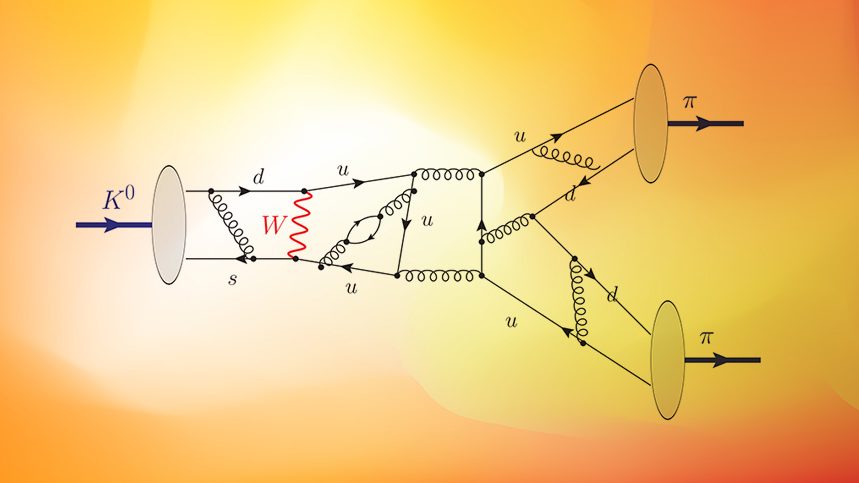
It might seem hard to believe, but the picture that most of us were initially taught — that protons and neutrons represented everything that made up the atomic nucleus — was one of the shortest-lived ideas in all of physics history. The proton was only discovered in 1917, by Ernest Rutherford: the same scientist who discovered the existence of the atomic nucleus itself. The neutron, meanwhile, was discovered in 1932 by James Chadwick, providing a massive, neutral counterpart to the proton. As most of us learn in school, protons and neutrons make up the atomic nucleus, and adding electrons around them gives us the atoms we recognize.
But beginning as early as 1934, physicists began to realize that making an atomic nucleus out of protons and neutrons couldn’t be the full story. Other ingredients, perhaps even more fundamental ingredients, would need to be added for the full picture to make sense. Quarks and gluons, today, are known to be those ingredients that make up protons and neutrons, but it took us a very long time to put the full picture together: not until the 70s, 80s, and 90s did we completely solve the puzzle. How did we get there? That’s what Patreon supporter Patrick Dennis wants to know, asking:
“What caused physicists to feel that protons and neutrons have substructure, and why did they settle on this schema?”
Let’s go all the way back to the 1930s to understand what motivated the idea of substructure inside the atomic nucleus, and then step forward through history to learn how the mystery of just what was inside of it was finally solved.
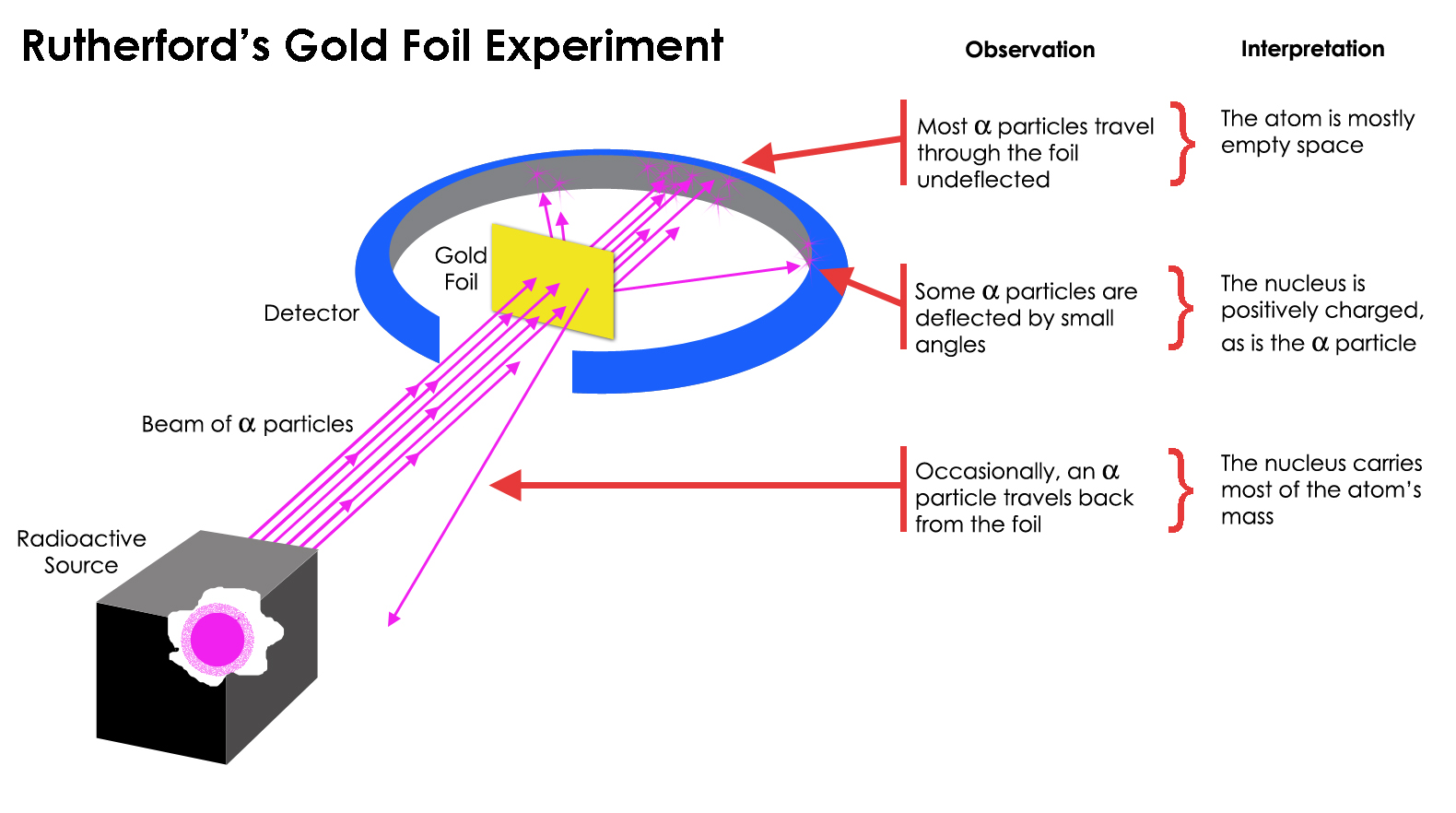
Up until the early 1900s, we knew about the existence of atoms, and that there were electrons contained within them. However, no one knew what the rest of the atom — the part that was left when you took away the electrons — would be like, save for the fact that most of the atom’s mass and an equal-and-opposite charge to the sum of the electron’s charge was present inside. That changed when Ernest Rutherford performed his now-famous gold foil experiment, bombarding a thin sheet of gold with radioactive particles emitted by a decaying atom. The fact that most particles passed through the sheet, but that a few bounced back, led Rutherford to later quip:
“It was quite the most incredible event that has ever happened to me in my life. It was almost as incredible as if you fired a 15-inch shell at a piece of tissue paper and it came back and hit you.”

That experiment revealed the presence of the atom’s nucleus: a small, positively charged core to the atom that carried most (more than 99.9%) of the atom’s mass. By examining argon and potassium, where argon is heavier (with an atomic mass of 40 but an atomic number of 18) but potassium has a higher charge to its nucleus (with an atomic mass of 39 but an atomic number of 19), we had a very big clue that there was an additional particle present inside the atom’s nucleus: a particle besides the proton. In 1932, James Chadwick discovered the neutron, and that led us to the picture you likely learned in school: that atoms are made of protons, neutrons, and electrons.
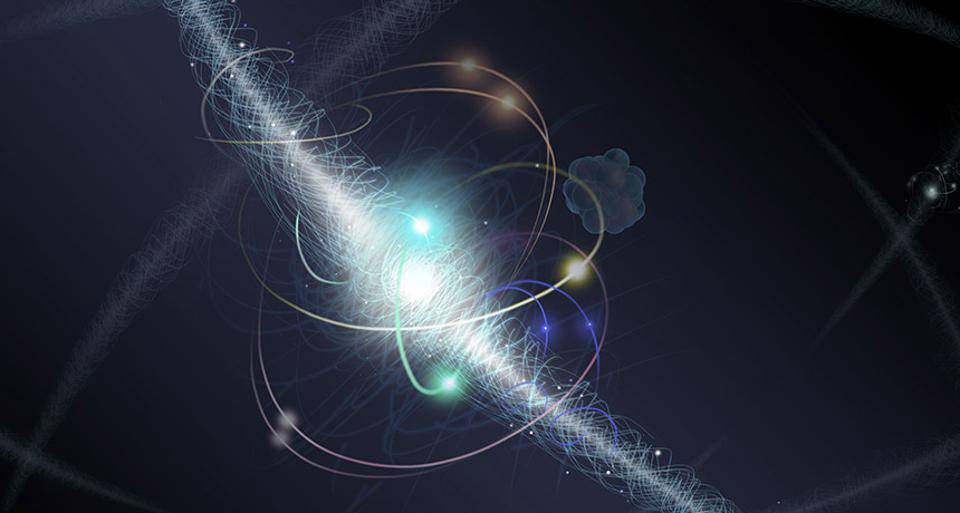
However, that picture wouldn’t last for very long. Think about it: if you have a dense nucleus of particles, and about half of them are positively charged (protons) and half of them are neutral (neutrons), then there ought to be an extremely strong repulsive force between all of the like charges (the positively charged protons) that are present inside. Unless there’s a stronger force than electromagnetism holding them all together, these nuclei would be unstable and would fly apart. Since that doesn’t happen, there must be a new force, some type of nuclear force, that holds these nuclei together.
The first to reach this conclusion was theorist Hideki Yukawa in 1934, who hypothesized that if the protons-and-neutrons within the nucleus exchanged a series of massive particles between them, with at least some of them being charged particles, then the nucleus of atoms could be stabilized. The strength of this attractive nuclear force would depend on the mass of whatever particles were exchanged within the nucleus, and Yukawa calculated that they would need to be somewhere around 10-20% the mass of a single proton: much heavier than an electron, but much lighter than a proton. Because of the intermediate nature of this hypothetical particle, it acquired a name to reflect its “in the middle” nature: the meson.

Unfortunately, there wasn’t a known particle that met those specifications. The surprising muon, discovered from cosmic ray experiments, had about the right mass to fit Yukawa’s description, but it turns out not to interact with atomic nuclei very much at all. (Today we know that the muon is a heavier generation version of the electron: a lepton, not a nuclear particle.) In India in the early 1940s, two physicists — Debendra Bose and Bibha Chowdhuri — put photographic plates out at very high altitudes in the mountains in the presence of a magnetic field, and observed the tracks that were produced. Surprisingly, they found tracks that differed from those of all the known charged particles (protons, electrons, muons, and other atomic nuclei) at the time.
It wasn’t until World War II had ended that peacetime research in nuclear physics resumed. When it did, the research of Bose and Chowdhuri was extended by others in Europe, including Cecil Powell, where it was determined that a new charged particle — one different from and slightly greater than the muon — could be seen decaying into muons! In 1947, Robert Marshak proposed that this particle was indeed Yukawa’s long-sought meson: the charged pion. By 1948, charged pions were produced and detected in particle accelerators, and in 1949, the neutral pion was identified as well.
Yukawa won the Nobel Prize in physics in 1949, Powell won the prize in 1950, and things would get even more interesting in the years ahead.

By this point, we knew of the proton, neutron, and electron, and also the photon, the muon, and the three pions: two charged and one neutral. (We also had knowledge of antimatter, and on theoretical grounds, neutrinos and antineutrinos as well.) Because there’s something “extra” in the nucleus besides the protons and neutrons — the pions or π-mesons — people began to wonder not only about the nature of the atomic nucleus, but also what the nature of these mesons were.
A key insight came from one of Yukawa’s collaborators, Shoichi Sakata, who took the knowledge that the charged pion was a boson and the muon (which the charged pion decays into) was a fermion and introduced yet another new particle: a second type of neutrino. Only if the charge pion decays into a muon and another (invisible) particle could both energy and momentum be conserved by the decay. Although Sakata proposed this solution in 1942, it wasn’t printed in English until 1946, due to World War II.
Additional mesons were soon discovered: an entire spectrum of them, in fact. Just as with the proton, neutron, and pions, there were a series of quantum numbers that could be defined for them: baryon number, isospin, electric charge, and in the 1950s, the concept of strangeness came along as well. A formula relating these quantities was discovered independently by two separate teams in the 1950s, and that’s what gave Sakata his key idea.
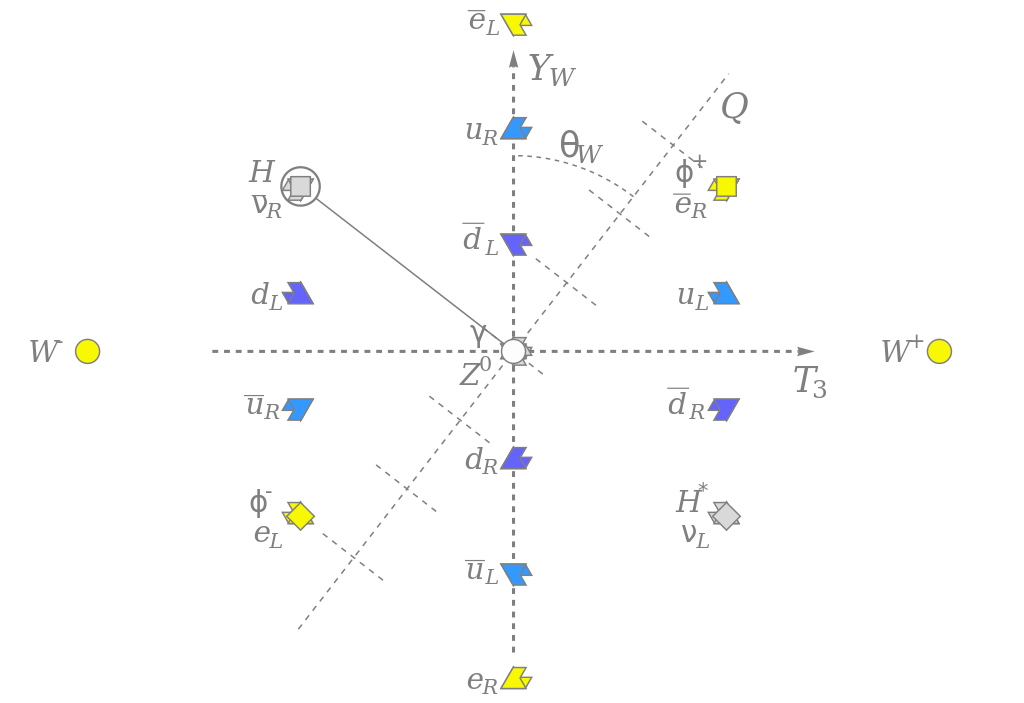
What could the physics behind this unintuitive rule be? Is there some simpler way to explain this newfound “zoo” of particles: the baryons and the mesons? There were more than just the proton, neutron, and pion now, including mesons like the kaons and baryons like the Lambda, Sigma, and Xi baryons. Unlike the proton, neutron, and pions, the kaons and these new baryons all had higher masses than the other mesons and baryons (respectively), and that new property of “strangeness.” It was in 1956 that Sakata published his most important idea: the Sakata model for particles.
Sakata’s idea was that there were only three “true” fundamental particles among this ever-growing zoo:
- the proton,
- the neutron,
- and the Lambda baryon,
as well as their antimatter counterparts. Sakata folded in another fact: that protons and neutrons can bind together in atomic nuclei, and when they do, the combination of protons and neutrons has a lower rest mass than the unbound (free) protons and neutrons that make those nuclei up: the concept of binding energy.
Sakata realized that all of the other particles — the pions, the kaons, the Sigma and Xi baryons, etc. — could be explained as combinations of either a combination of a proton, neutron, or Lambda with an antiproton, antineutron, or antiLambda (for the mesons), or as a combination of two from the [proton, neutron, Lambda] category with one from the [antiproton, antineutron, antiLambda] category (for the baryons).
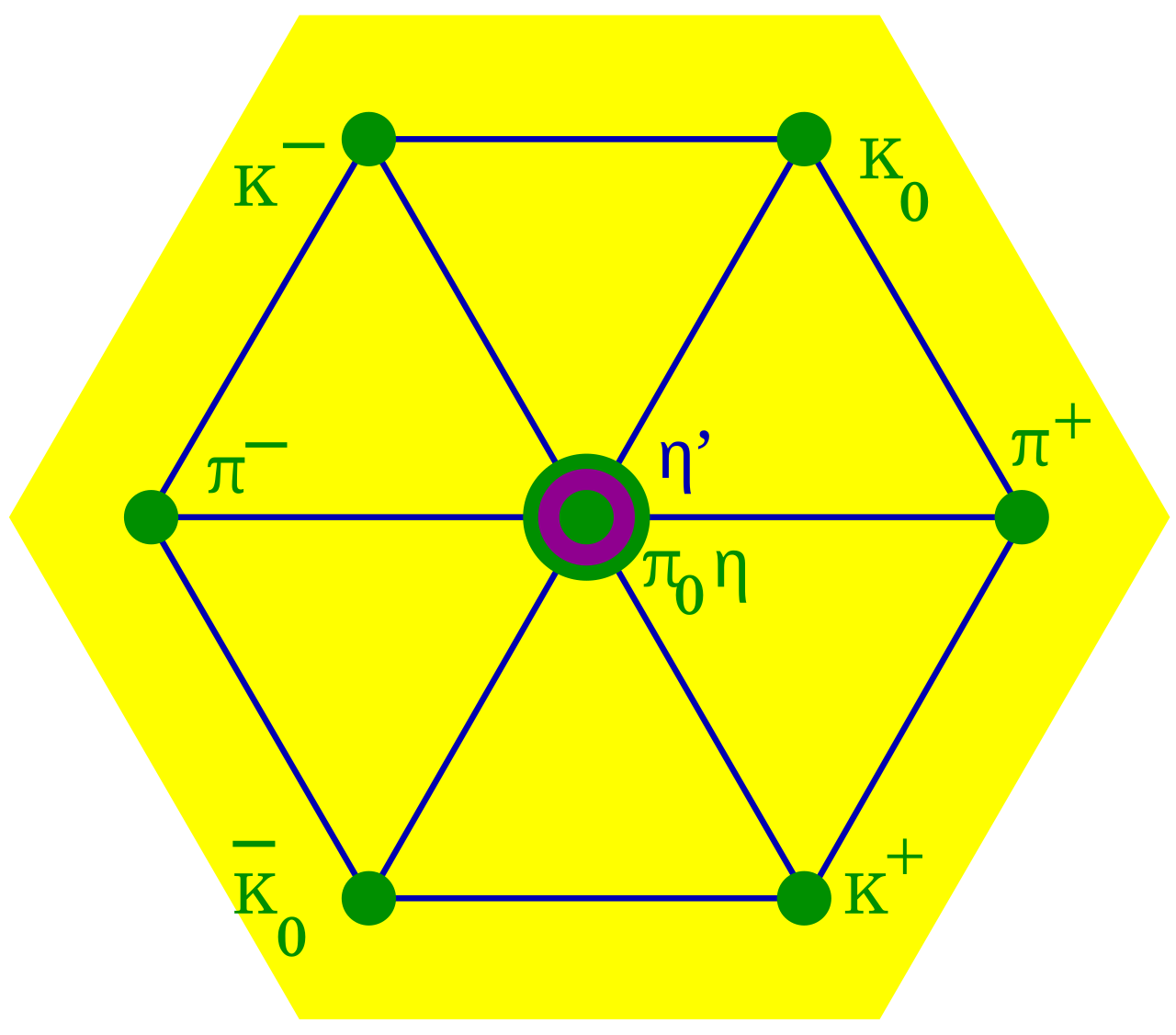
For example, the pions come in three species: the π+, π–, and π0. Sakata saw that the quantum numbers would all work out perfectly correctly if you modeled them as follows:
- π+: a proton bound together with an antineutron.
- π–: a neutron bound together with an antiproton.
- π0: either a proton-antiproton or a neutron-antineutron combination.
The kaons could be explained by substituting a Lambda (or antiLambda) for one of the particles typically used to make a pion, and all the quantum numbers work out. And there’s a similar story for the heavy baryons as well.
The model was controversial, however. While it did provide a nice explanation for the already-observed particles and how their quantum numbers behaved, there were many who objected to it. One major objection was that binding energy between protons and neutrons, as observed in deuterium or helium, for example, only had a minor effect on overall mass: where the bound nuclei were not even 1% less massive than the individual components inside. How could the pions, then, wind up over 90% less massive than the constituent protons and neutrons that made them up?
However, another piece of evidence soon came along, in the 1960s, that would prove the Sakata model wrong: the rise of deep inelastic scattering experiments.

We knew that atoms had a finite size that was small, but only relative to our macroscopic world: about a tenth of a nanometer (10-10 meters) in size. We also knew, going all the way back to Rutherford, that the atomic nucleus, made of protons and neutrons, was even smaller, containing nearly all of the atom’s mass. But how small was the nucleus, and was there anything inside of individual protons and/or neutrons? The way to tell was to fire truly point-like particles — particles such as electrons, positrons, muons, or even neutrinos — at a proton, and observe the aftermath.
Particles, as shown by Louis de Broglie back in the early days of quantum mechanics, don’t behave as “points” under most circumstances, but rather as waves: with a wavelength that depends on the particle’s total energy. Because we now had the ability to use electric fields (and electromagnets) to accelerate and direct particles, we could perform experiments where we bombarded protons with these point-like particles at higher and higher energies: where their de Broglie wavelengths became smaller and smaller. Based on how the point-like particles deflect, or based on whether the target particle is destroyed (and by measuring the debris that emerges in the aftermath), much can be learned about the target particle’s nature.

These deep inelastic experiments revealed two remarkable properties, even in the early days:
- they helped measure the size of individual protons and neutrons, determining them to be around a femtometer (10-15 meters) in size,
- and they revealed that when probed with energies that are about double (or more) of the rest-mass energy of a π-meson, a wide array of mesons, along with at least one net baryon, would emerge in the aftermath.
This showed that instead of mesons being made out of protons and neutrons (and Lambdas, etc.), the truth was that protons, neutrons, Lambdas, and even the mesons were all made of even smaller constituents. In the 1960s and even into the 1970s, many people continued to use the Sakata model because of how successful its predictions were for yielding the relationships between various quantum properties.
However, two other ideas rose to prominence in the aftermath of these experiments: the theoretical quark model, put forth by Murray Gell-Mann, and the experimentally-driven parton model, championed by Richard Feynman. Today, we understand that quarks define a particle’s species, and that the parton model is compatible with the quark model: those are the defining characteristics of a proton, neutron, or any other meson or baryon, collectively known as hadrons.

It wasn’t until the 1970s that our picture of nuclear substructure finally crystallized, as we discovered:
- evidence for additional particles, including ones that contained charm and bottom quarks,
- the concept of asymptotic freedom, allowing us to understand how the strong nuclear force works,
- and then, in 1979, there was the direct discovery of the gluon: the force-carrying particle of the strong nuclear force, found inside of all hadrons.
However, the story of the proton’s substructure didn’t come about because of any one unique discovery or any one stroke of theoretical genius. Instead, it was due to the work of many important people — from many different countries all around the world — in both theory and experiment, over a span of more than 40 years. Important contributions to the story came from Asia, Europe, the Americas, and more.
Moreover, it’s kind of remarkable, when you think about it, that the picture we learn of atoms — that they’re made of protons, neutrons, and electrons — was only ever thought to be a “fundamental” picture of reality for about two years, from 1932 (when the neutron was discovered) until 1934 (when the necessity of a new nuclear force was demonstrated). After that, we knew there was something more to the atomic nucleus; it just took us until the 1970s to determine precisely what that picture was. Today we know that quarks and gluons are responsible for the largest particle zoo of all-time: baryons, mesons, and even tetraquarks and pentaquarks. As far as we know, the Standard Model particles are truly indivisible and fundamental. But there’s more physics to be found out there in the Universe, if only we dare invest in exploring it beyond the currently known frontiers.
Send in your Ask Ethan questions to startswithabang at gmail dot com!

The Power of Play