How one decision can create “a new self” From Copernicus to Flatland, Yale philosopher L.A. Paul shares examples of transformative experiences, and how participating in them changes more...
Galaxies can be found along, nearby, and within cosmic filaments. There is often both neutral and ionized matter within the haloes of these galaxies as well as along their line-of-sights, so when that light arrives, those absorption features seen in their spectra can tell us what the density and temperature of matter was in their own circumgalactic mediums, as well as for intervening galaxies and our own Milky Way. The galaxies and gas, which emit and absorb light, are biased, imperfect tracers of the underlying mass distribution, which includes, and is dominated by, the more diffuse dark matter.
Credit: CXC/M. Weiss; NASA/CXC/Univ. of California Irvine/T. Fang
Inside our observable Universe, there are trillions upon trillions of planets, stars, stellar remnants, galaxies, and even larger structures for us to find out there.
While in our common experience, stars are larger than planets and galaxy groups and clusters are larger than individual galaxies, there are remarkable outliers that defy those general trends.
Here are the largest and smallest objects known across the fascinating and diverse cosmos. Within each category, some variations are negligible, while others are truly profound.
An astrophysics column on big questions and our universe.
Fully comprehending our Universe requires imagining extraordinarily different scales.
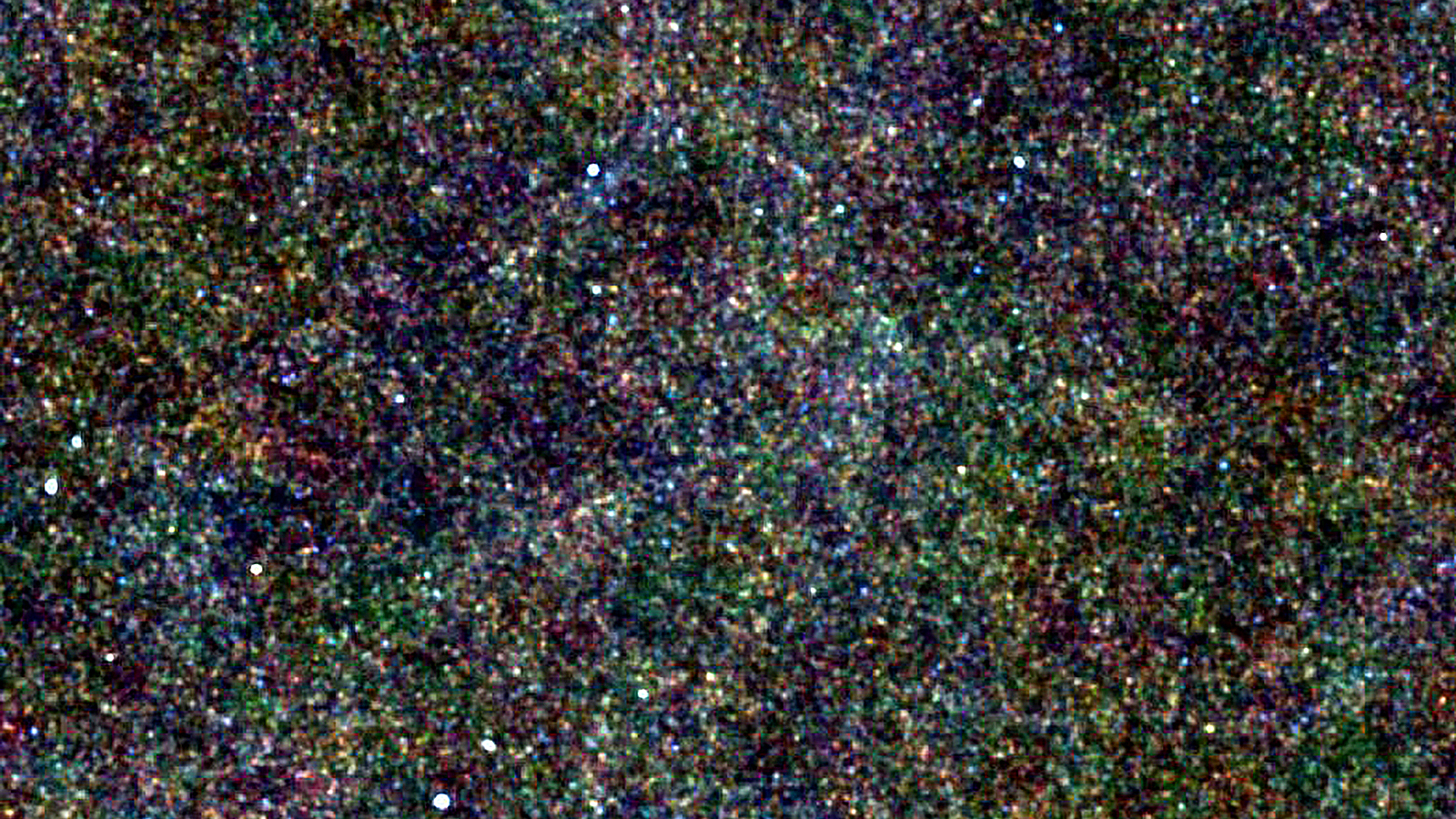
A region of space devoid of matter in our galaxy reveals the Universe beyond, where every point visible here is a distant galaxy. The cluster/void structure can be seen very clearly, demonstrating that our Universe is not of exactly uniform density on all scales. While there are many galaxy-rich regions, galaxy-poor or even galaxy-free regions are also abundant, like holes within a cosmic Swiss cheese. Within this cosmic web, many smaller, bound structures are present, but they are not resolvable on this scale.
Astronomically, many grand structures naturally arise.
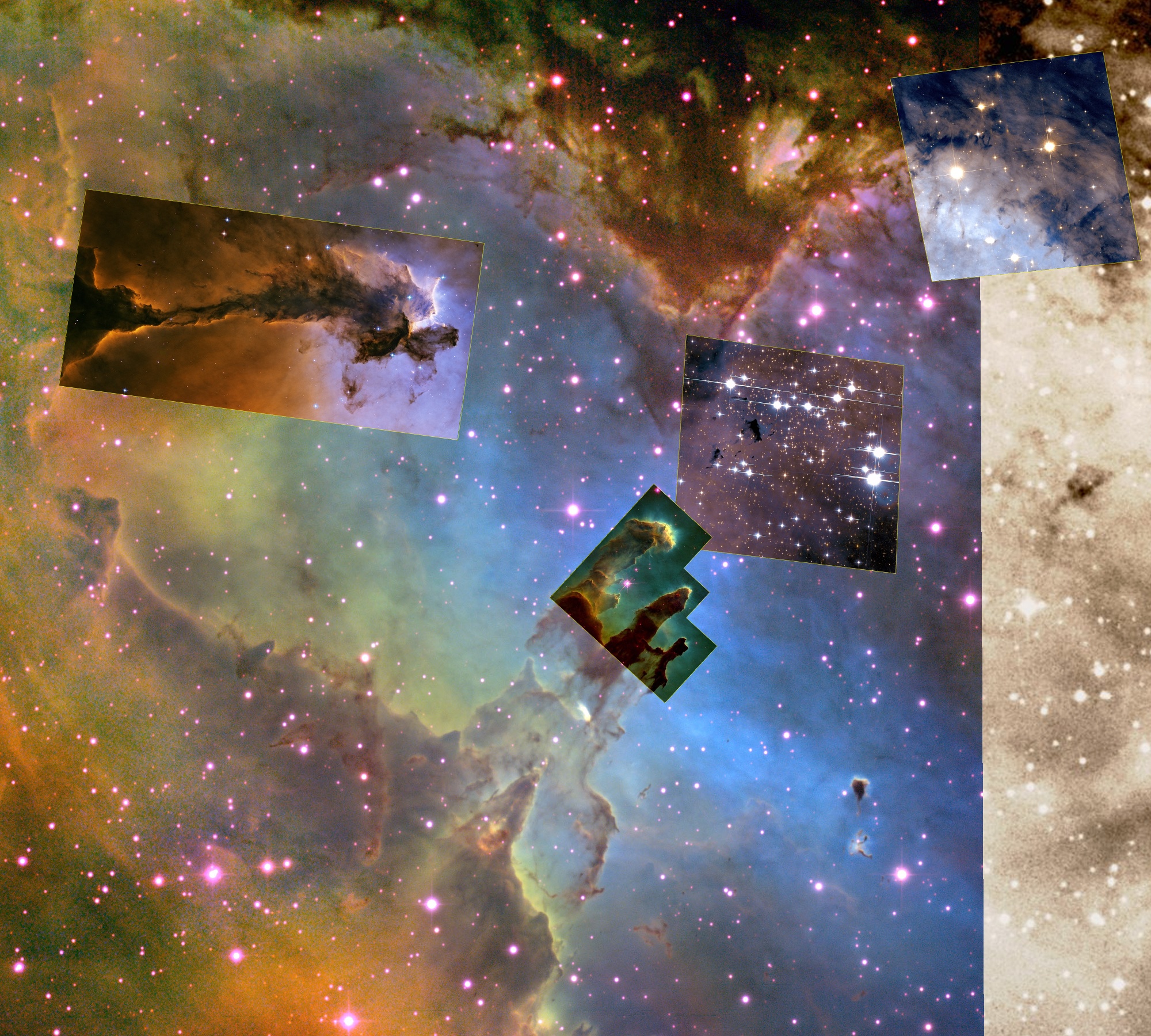
A large section of the Eagle Nebula, with four of the Hubble Space Telescope’s iconic images superimposed atop the relevant region of the larger nebula. Although these features, highlighted by the central Pillars of Creation, are incredibly interesting because of the neutral matter still present, most of the nebula is instead simply an empty, cavernous void littered with isolated stars and star clusters. With only a few thousand new stars inside, it showcases how spectacular, but how rare, star-formation episodes are in today’s Milky Way.
Credit: ESA/Hubble and NASA; Wikimedia Commons user Friendlystar
Below 200-500 kilometers in size, electromagnetic forces, not gravity, dominate.
The four largest asteroids, all shown here, have been imaged with NASA’s Dawn mission and the ESO’s SPHERE instrument. Ceres, the largest asteroid, is the smallest known body definitively in hydrostatic equilibrium. Vesta and Pallas are not, but Hygeia, with a smaller mass but a much lower density, may yet be; its status is indeterminate.
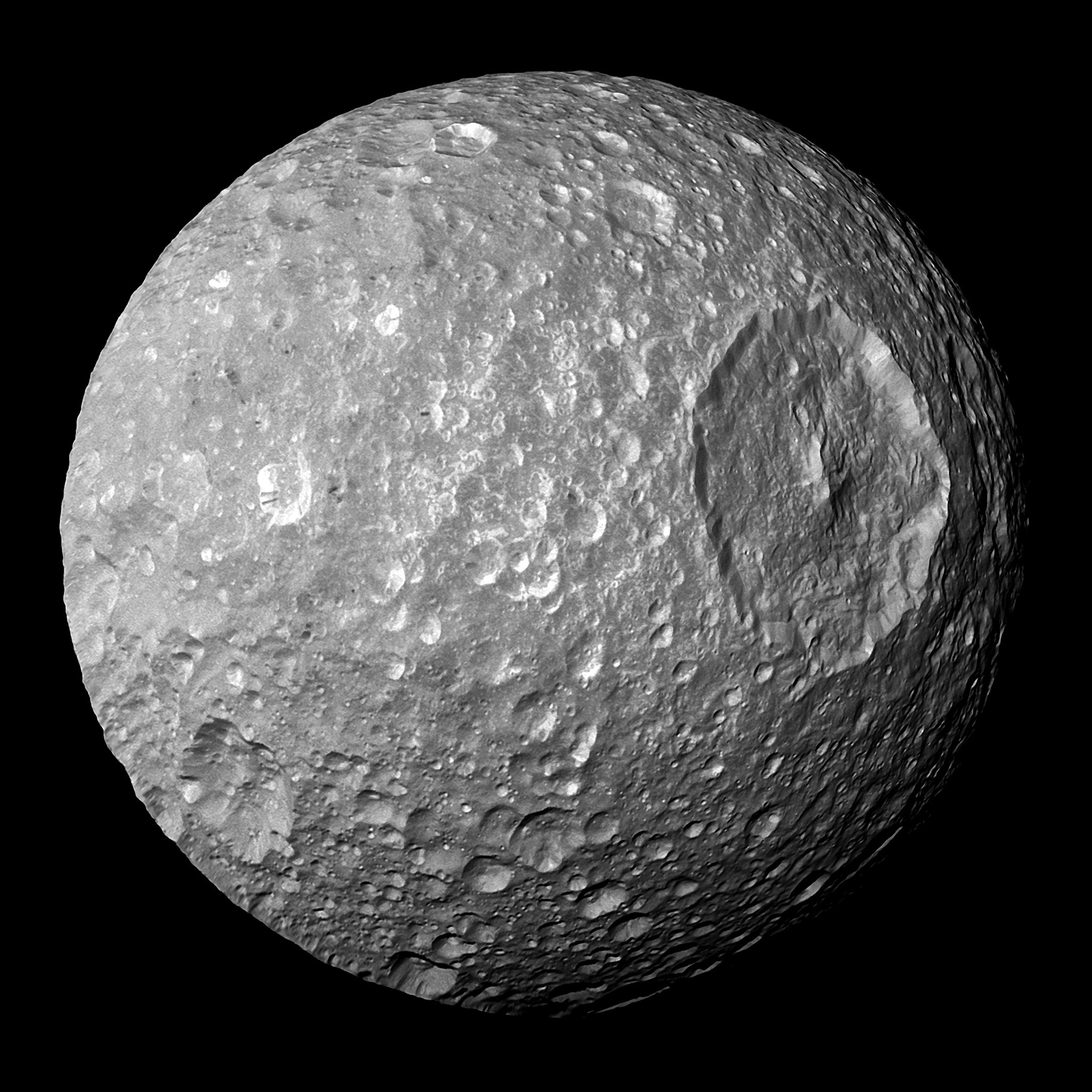
Mimas, as imaged here during the closest fly-by of Cassini in 2010, is only 198 kilometers in radius, but is quite clearly round in shape, and may represent the smallest, lowest-mass body known that’s actually in hydrostatic equilibrium due to self-gravitation. Being made mostly of ice, it does what the larger asteroids Vesta and Pallas cannot: pull itself into a spheroidal shape. However, it doesn’t appear to fully be in hydrostatic equilibrium today, as the large crater visible here, Herschel, shouldn’t persist with its present properties if the world were still shaped by self-gravitation.
The smallest planetary bodies are hundreds of kilometers across.
Although there are many known exoplanets with a larger mass than Jupiter, most of them aren’t physically larger than Jupiter. Instead, the largest-radius planets are “super-puff” planets like WASP-17b, with only half of Jupiter’s mass but with a diameter that’s nearly double Jupiter’s: 262,000 km.
Credit: Wide-Angle Search for exoPlanets/Cole Hellier
Gliese 229 is a red dwarf star, and is orbited by Gliese 229b, a brown dwarf, that underwent deuterium fusion only, never progressing to fusing protons with other protons. Although Gliese 229b is about 20 times the mass of Jupiter, it’s only about 47% of Jupiter’s radius: smaller despite being more massive, and possibly the smallest brown dwarf known.
Credit: S. Kulkarni (Caltech), D. Golimowski (JHU) and NASA/ESA
Brown dwarfs — failed stars — are only Jupiter-sized.
This graphic compares a Sun-like star with a red dwarf, a typical brown dwarf, an ultra-cool brown dwarf, and a planet like Jupiter. Only about 5% of all stars are like the Sun or more massive; K-type stars represent 15% of all stars, while red dwarfs represent 75-80% (or more) of all stars. Brown dwarfs, although they are failed stars, may be just as common as red dwarfs are, but are even cooler and lower in mass, and comparable in size to Jupiter.
This artist’s impression of Proxima b, the Earth-sized planet at the right distance from Proxima Centauri for liquid water to exist on its surface, remains one of the most compelling nearby candidate planets to search for potential signs of habitability: primarily due to its temperature and proximity.
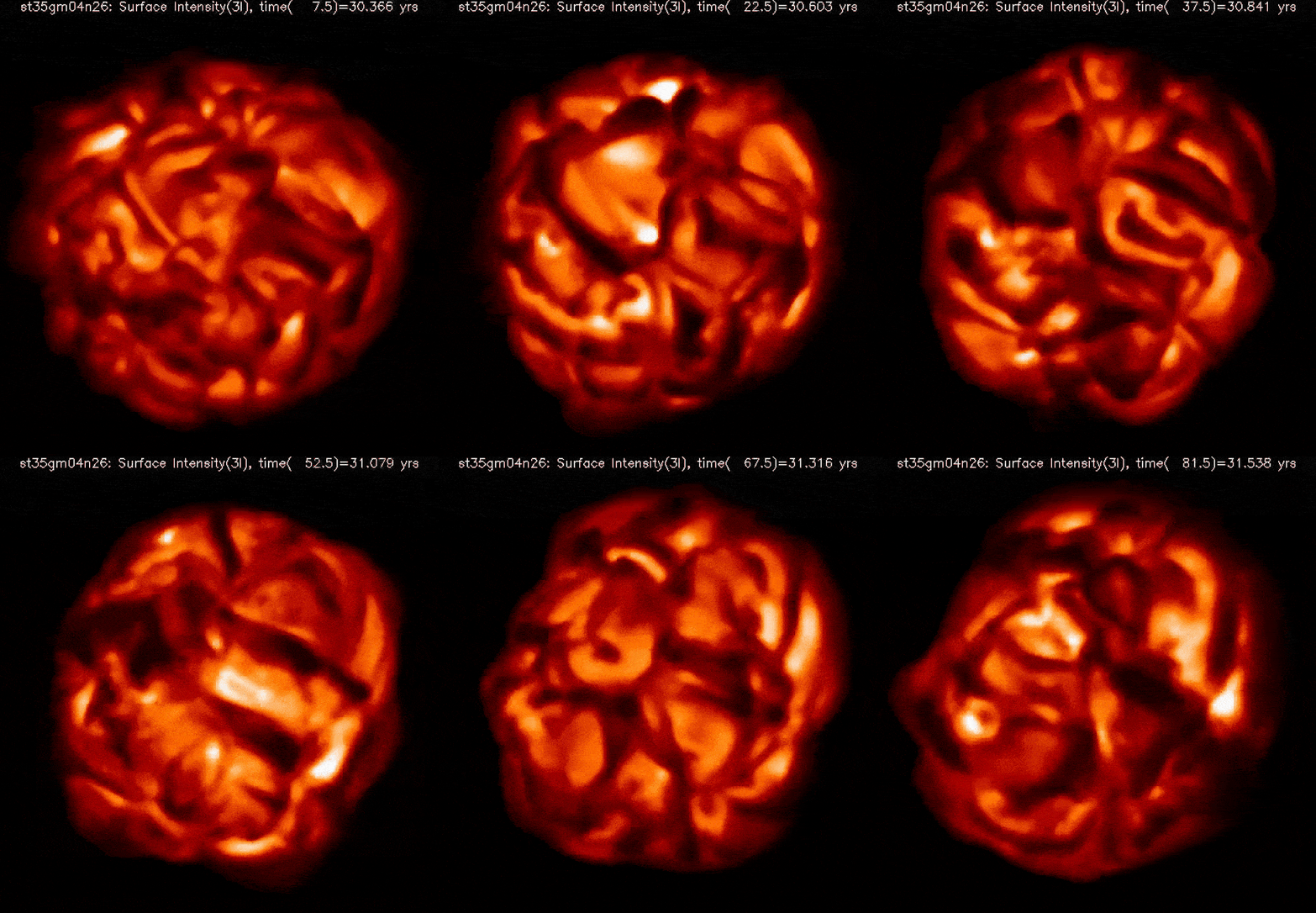
This simulation of a red supergiant’s surface, sped up to display an entire year of evolution in just a few seconds, shows how a “normal” red supergiant evolves during a relatively quiet period with no perceptible changes to its interior processes. Red supergiants are often over 1000 times the physical diameter of our Sun, and routinely exceed the size of Jupiter’s orbit around the Sun. The star Stephenson 2-18 was claimed to have a size of around Saturn’s orbit, but that assertion remains contested.
Stars evolve into stellar remnants: white dwarfs, neutron stars, and black holes.
Although the amount that spacetime is curved and distorted depends on how dense the object in question is when you’re close to the object’s edge, the size and volume that the object occupies is unimportant far away from the mass itself. For a black hole, neutron star, white dwarf, or a star like our Sun, the spatial curvature is identical at sufficiently large radii. However, close to the event horizon of a black hole, more severe curvatures are achieved than anywhere else. Far away from all of these sources, spacetime is asymptotically flat, but neither perfectly flat nor truly empty.
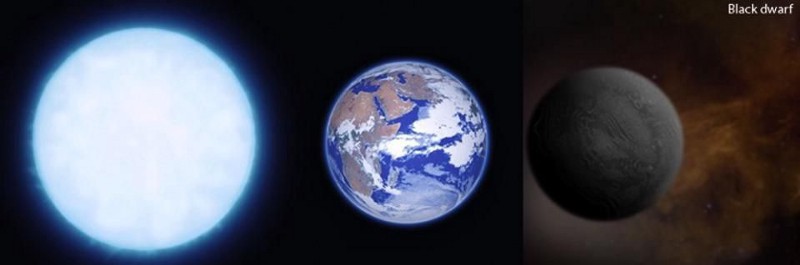
An accurate size/color comparison of a white dwarf (left), Earth reflecting our Sun’s light (middle), and a black dwarf (right). When white dwarfs finally radiate the last of their energy away, they will all eventually become black dwarfs. The physical size of a white dwarf scales inversely with its mass, with the lightest white dwarfs being the largest, at around double Earth’s size, while the heaviest white dwarfs are the smallest, at around the size of Earth’s Moon.
They range from Moon-sized to twice Earth’s diameter: 4,280-26,000 km.
The two best-fit models of the map of the neutron star J0030+0451, constructed by the two independent teams who used the NICER data, show that either two or three ‘hot spots’ can be fitted to the data, but that the legacy idea of a simple, bipolar field cannot accommodate what NICER has seen. This neutron star measures just ~12 km in radius, where neutron stars represent both the densest non-singular objects in the Universe and also the hottest at their surfaces.
When two neutron stars merge, they always produce a gravitational wave signal. However, dependent on a variety of factors, with mass being especially important, these neutron star mergers may or may not produce an electromagnetic signal as well. If they do, it does not arrive simultaneously with gravitational waves, but slightly later. The first neutron star-neutron star merger detected in gravitational waves, GW170817, made a black hole of approximately 2.7 solar masses: the smallest one yet known.
Credit: National Science Foundation/LIGO/Sonoma State University/A. Simonnet
Although the “horseshoe” feature of the lensed background galaxy in the “cosmic horseshoe” system is clearly the most visually striking feature, the smaller features, in the two boxes, are gravitationally lensed copies of the same background galaxy, where the radial arc near the galactic center provides astronomers with an exquisite window into the dynamics of the stars near the central black hole. The black hole present inside is constrained to be 36 billion solar masses with very small errors: the heaviest black hole known with such small error bars.
Credit: C.R. Melo-Carneiro et al., Monthly Notices of the Royal Astronomical Society, 2025
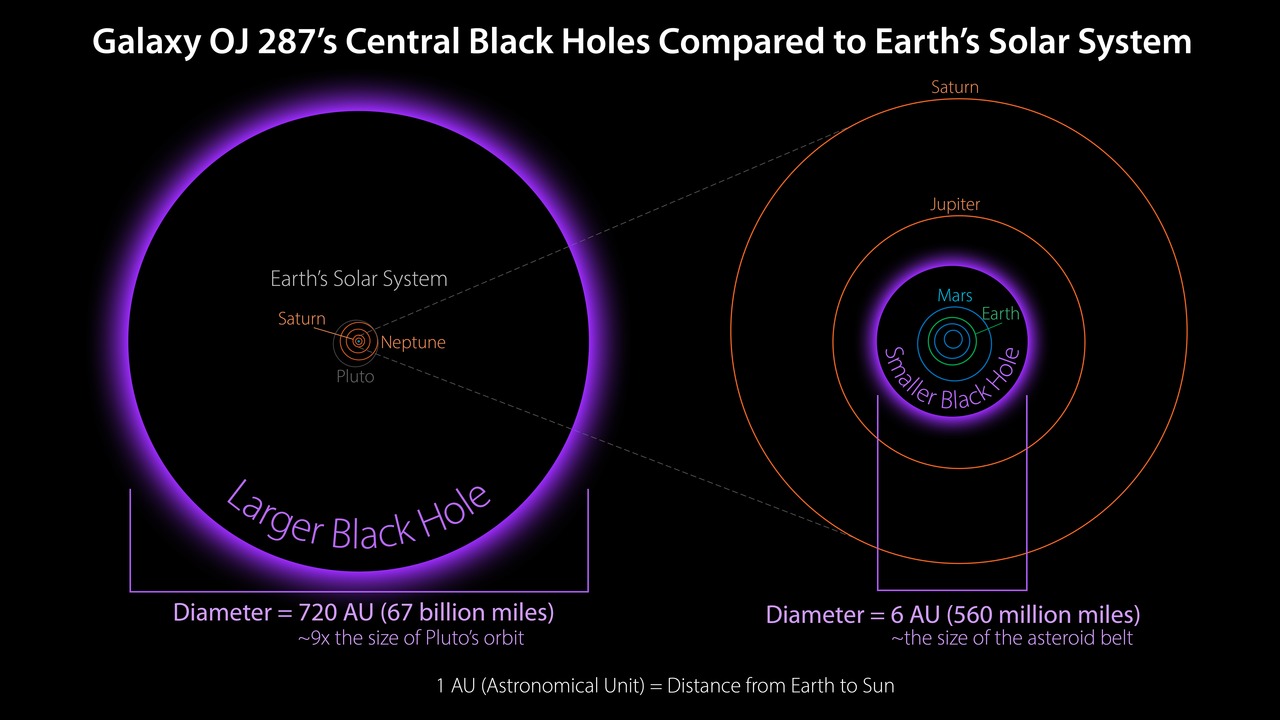
This diagram shows the most massive binary black hole system known, OJ 287, with the sizes of its two black holes (18 billion and 150 million solar masses, respectively) relative to the size of our Solar System. Although more massive single black holes are known, OJ 287, discovered way back in the 1880s, remains the most massive pair of black holes seen to date.
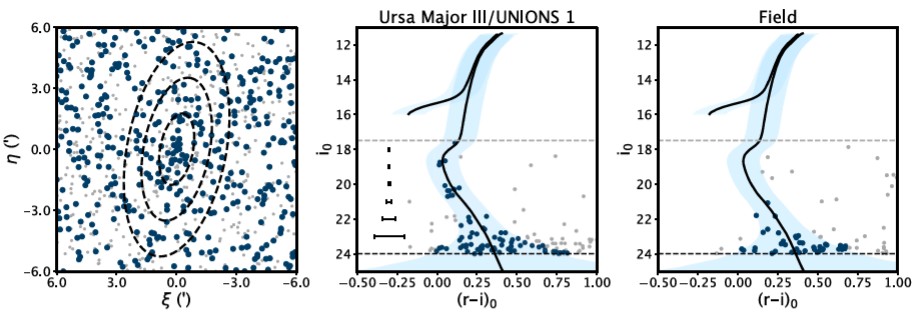
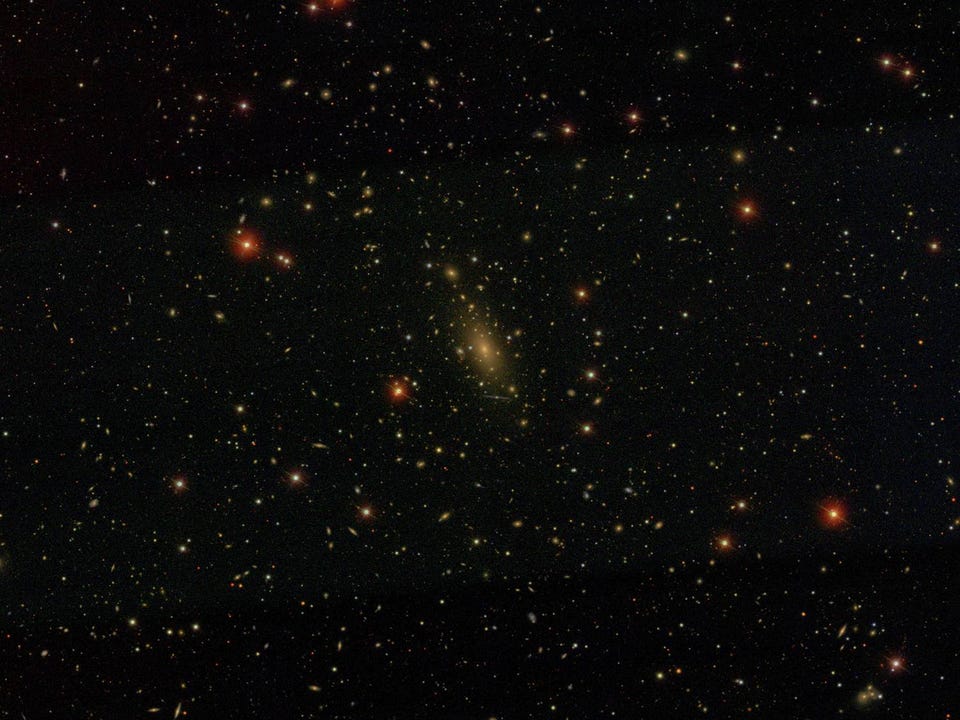
The stars in the vicinity of the identified object Ursa Major III/UNIONS 1 (at left) can be sorted into stars that are identifiable members (or candidate members) by color/magnitude considerations (at center) and distinguish them from Milky Way halo stars in their vicinity (at right). This may merely be the last remnants of a globular cluster, but it could also be the smallest dwarf galaxy ever discovered: with a half-light radius of only 10 light-years at its distance of 33,000 light-years away.
Credit: S.E.T. Smith et al., Astrophysical Journal, 2024
The largest, IC 1101, covers 6 million light-years.
The giant galaxy cluster, Abell 2029, houses galaxy IC 1101 at its core. At 5.5 million light-years across, over 100 trillion stars and the mass of nearly a quadrillion suns, it’s the largest known galaxy of all. As massive and impressive as this galaxy cluster is, it’s unfortunately difficult for the Universe to make something significantly larger owing to its finite age and the presence of dark energy.
Galaxy groups/clusters can be compact (~500,000 light-years),
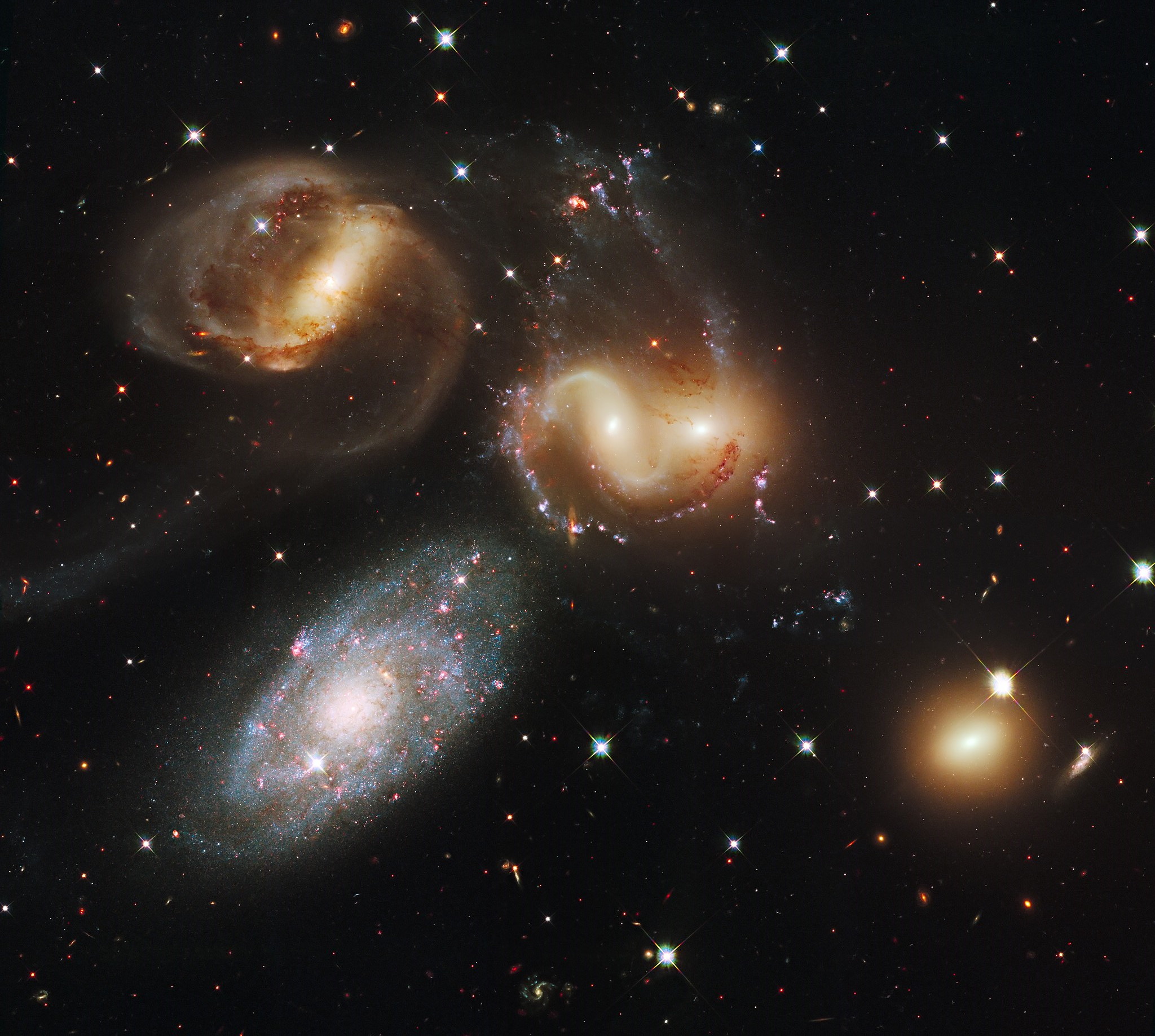
The first compact group of galaxies to ever be discovered, Stephan’s Quintet, is actually just a major component of a larger, more extended group of a greater number of galaxies some 290 million light-years away, photobombed by one interloping foreground galaxy (the prominent, pink spiral) just 40 million light-years away.
This composite image, combining optical imagery with gravitational lensing mass map reconstructions and X-ray emission data from the Chandra Observatory, reveals the Train Wreck cluster, Abell 520, in gory detail. At approximately 23 million light-years from end-to-end, this set of multiple colliding galaxy clusters is one of the largest known bound structures in all of the cosmos.
The radio data from LOFAR and GMRT clearly shows the features of a coherent, bipolar, linear black hole pair of jets that extend for 23-24 million light-years in extent. This feature, named Porphyrion, is the largest black hole jet ever seen.
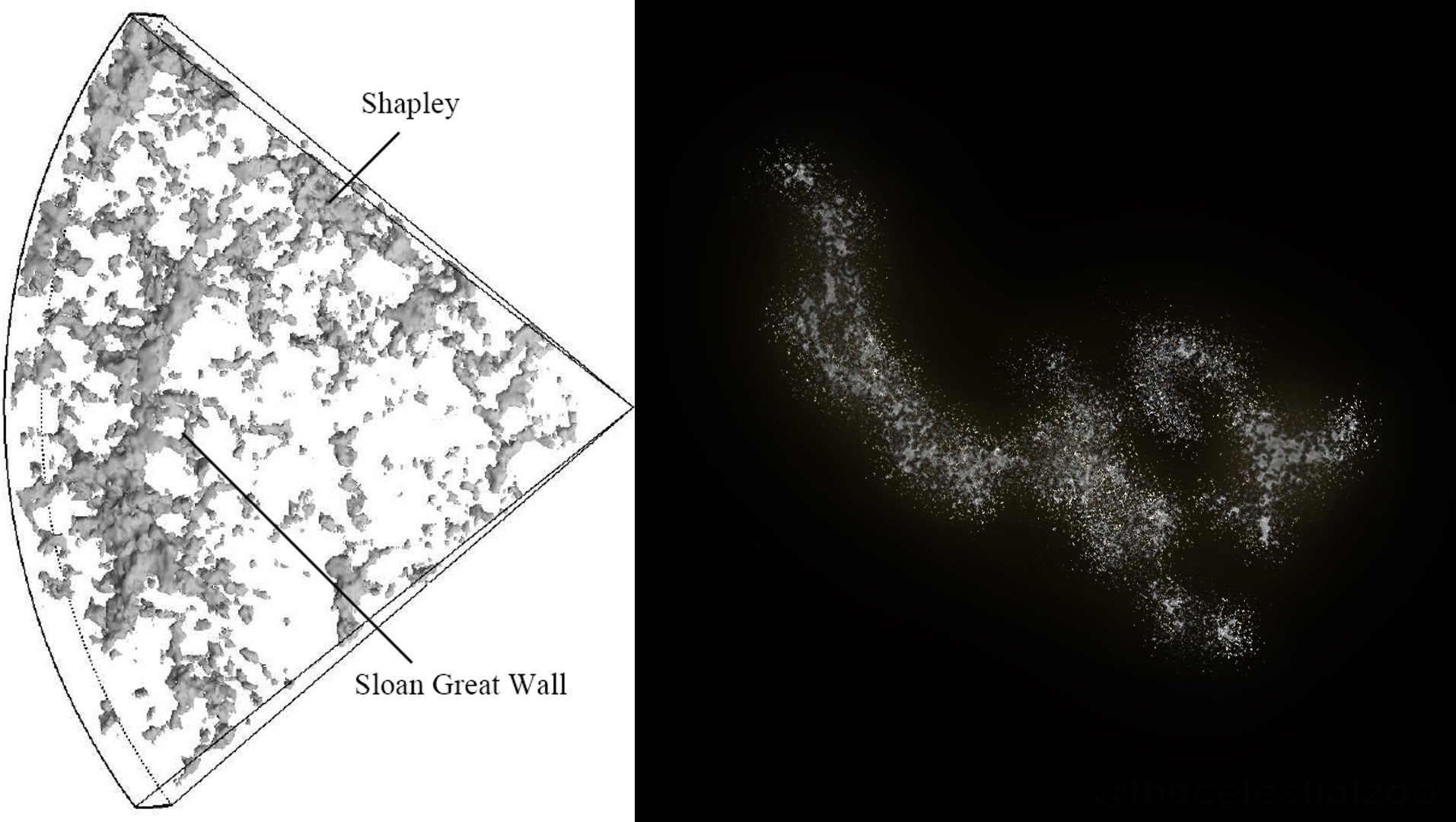
The Sloan Great Wall is one of the largest apparent, though likely transient, structures in the Universe, at some 1.37 billion light-years across. It may just be a chance alignment of multiple superclusters, but observations definitively indicate that it isn’t a single, gravitationally bound structure, as dark energy is in the process of driving it apart. The galaxies of the Sloan Great Wall are depicted at right. In 2025, a structure about 2% longer, Quipu, was discovered, although the uncertainties on their sizes overlap with each other, as well as with the South Pole Wall.
Credit: Willem Schaap (L); Pablo Carlos Budassi (R)/Wikimedia Commons
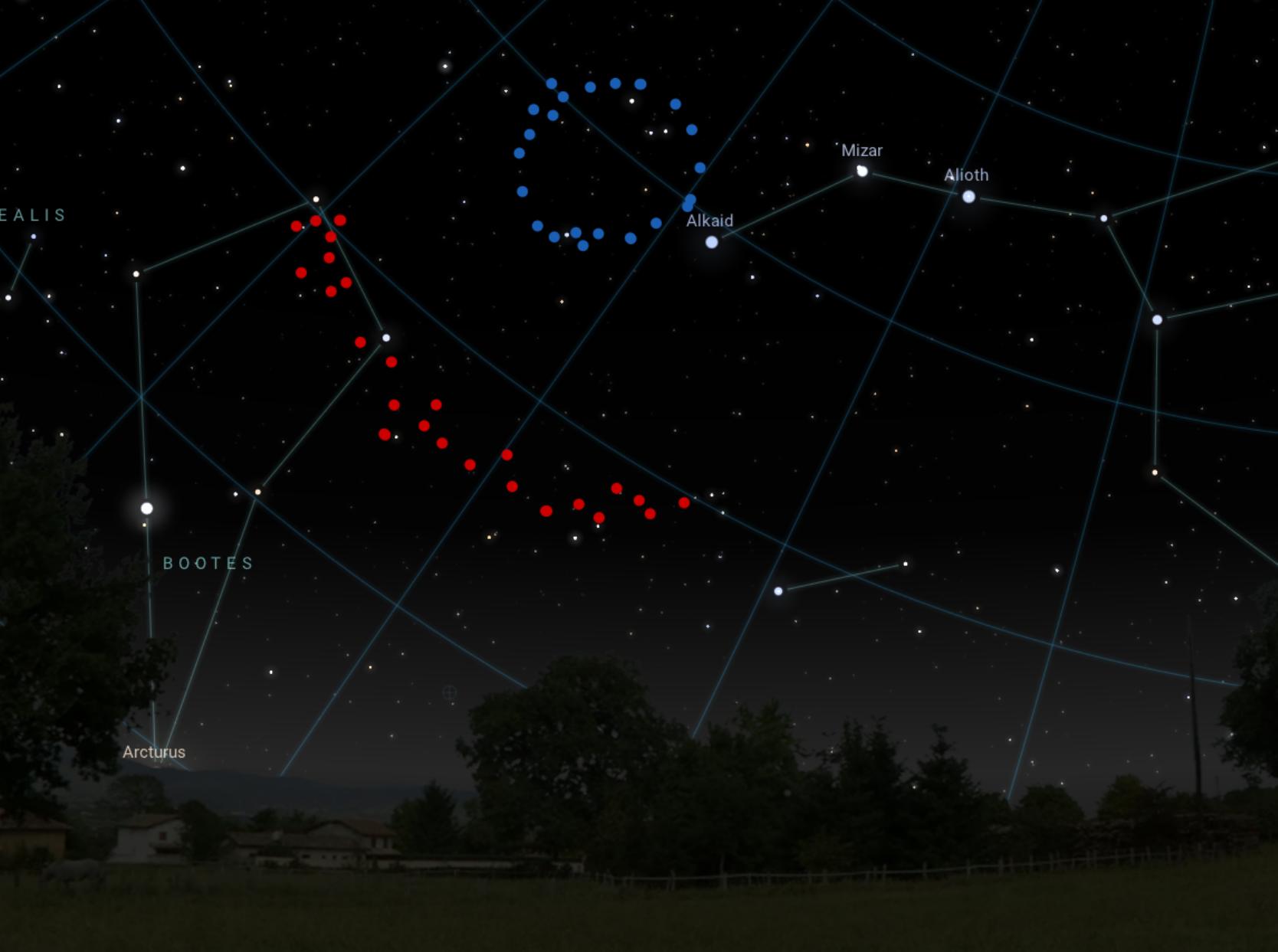
The “Big Ring” of ionized magnesium absorbers, in blue, is shown alongside the “Giant Arc” of ionized magnesium absorbers, in red. While it’s plausible that some or all of these objects are related as part of a connected structure, it’s also possible that every single point is unrelated to every other point in this image; there is no “mapping” of the Universe that has convincingly established the reality of these structures. They may simply be unconnected points that our minds, and eyes, are too tempted to do anything other than connect.
Credit: Stellarium/University of Central Lancashire
Mostly Mute Monday tells an astronomical story in images, visuals, and no more than 200 words.