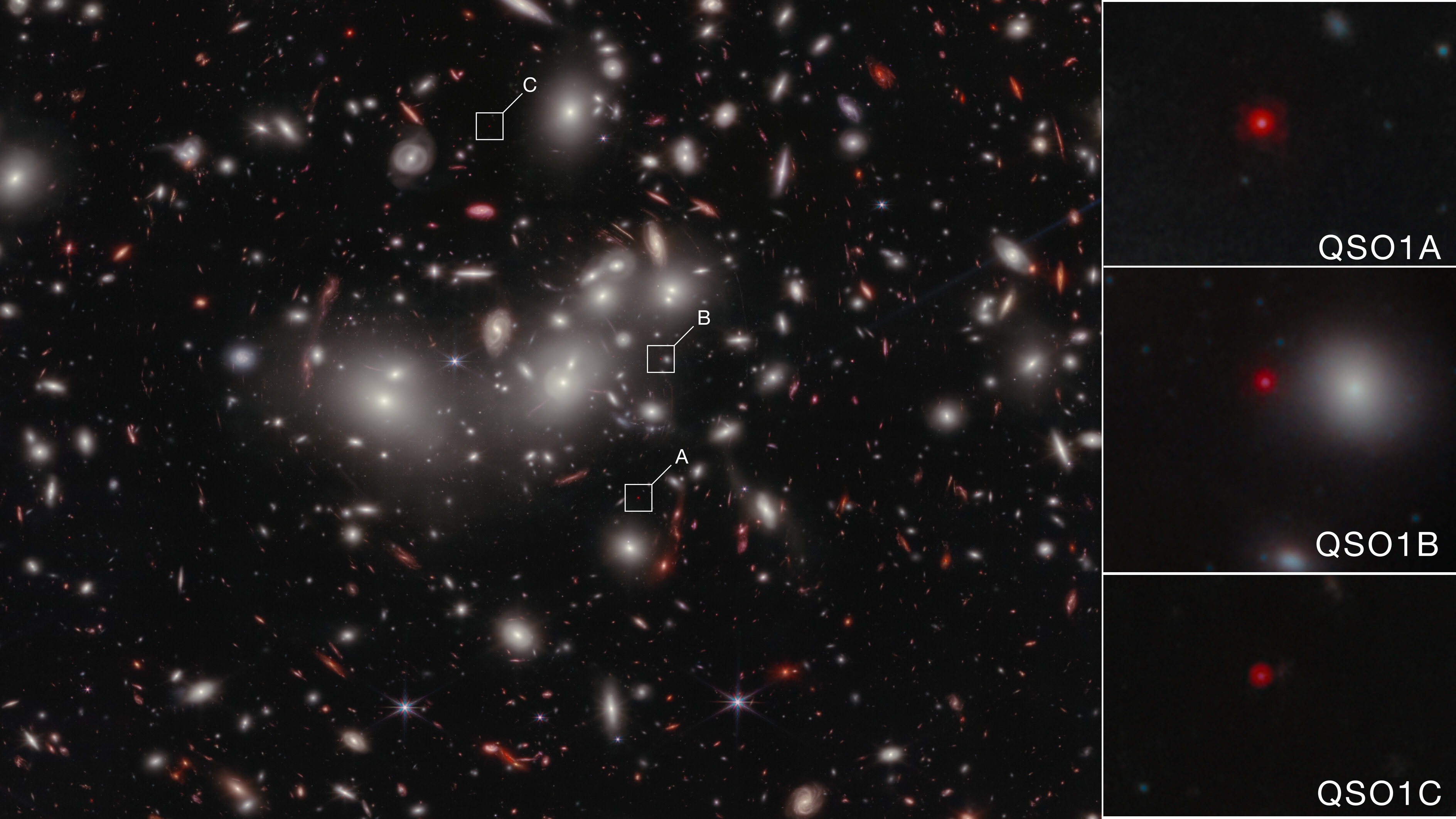
When we look out into the Universe, all that we see represents only a snapshot of our 13.8 billion year cosmic history: a glimpse of how it appears to us at this particular moment. For us, we define that as “right now” in the sense that this is what the arriving light is revealing to us. However, because the speed of light is finite, we’re seeing these objects as they were some time in the past: enabling us to look back through time as we look farther away in space. Compared to the way it is today, we know that our Universe evolved and grew up from a pristine state — a state where stars like the Sun, planets like Earth, and life like humans wasn’t yet possible — to form the modern Milky Way, our Sun, planet Earth, and the multi-billion year history of life that, today, has led to us.
The earliest stars that we had were made of hydrogen and helium alone: with no heavy elements and no chance for rocky planets around them. Only in the aftermath of many generations of stars did the interstellar medium, the place where molecules gather to trigger new episodes of star-formation, become enriched enough to create Earth-like planets and Sun-like stars. The study of that process is known as stellar archaeology.
Similarly, our own galaxy grew up from the accretion, infall, and merger of streams of matter, smaller galaxies, external globular clusters, and much more: giving rise to the modern Milky Way. The study of our own galaxy’s structure, formation history, and evolution, as well as the best picture of all of it that we can reconstruct, is similarly known as the field of galactic archaeology.
Even though the science is truly awe-inspiring, it’s a misnomer to call this “archaeology” in any way. Here’s what astronomers presently do, and what performing true stellar archaeology or galactic archaeology would actually entail. We’d love to truly be able to conduct “galactic archaeology,” but we lack the capability to do so with our current understanding of things. Here’s why.

Our Sun, as we understand it, is a giant ball of gas and plasma, composed of approximately 70% hydrogen, 28% helium, about 1% oxygen, and around 1% of everything else: carbon, nitrogen, silicon, sulfur, iron, neon, calcium, magnesium, and much more. When we look out at the stars we find nearby — the stars within the Milky Way, our open star clusters, and our galaxy’s globular clusters — we see that they have a wide variety of properties. Many are like the Sun in terms of composition, particularly the stars that:
- are located within the galactic plane,
- are found closer to the galactic center,
- and that formed recently, within the past few billion years.
These are stars that are, like our Sun, heavily enriched with the material formed from prior generations of stars: what we call Population I stars, most of which have planets, including rocky planets, orbiting them.

But stars that are less enriched — generally that formed long ago, from regions of space that had experienced the formation of fewer generations of prior stars — are generally found out of the galactic plane, far from the galactic center, or in the most ancient globular clusters of all: Population II stars. In theory, although we have yet to spot them, there should even be Population III stars, or stars made from material that had never previously been inside a star since the start of the hot Big Bang.
The study of how we got from there to here, and how the history and composition of the Universe (as well as the stars within it) have evolved and grown up, is at the core of what we call stellar archaeology.
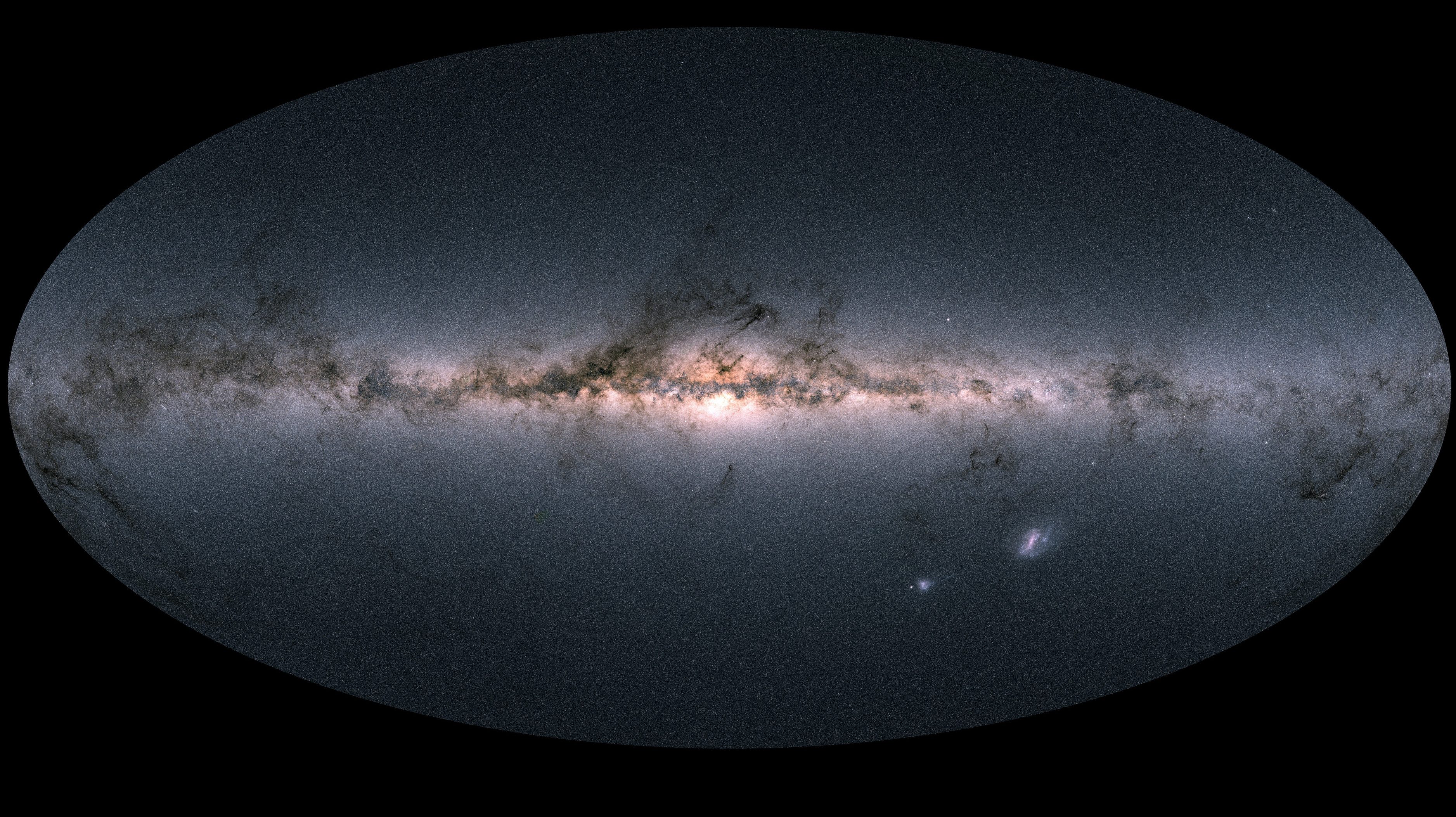
Of course, we care very deeply about not just how the stars and stellar populations in the Universe evolve and grow up, but about how that all unfolds here in our home galaxy that, ultimately, gave rise to us: the growth and evolution of our own Milky Way. Today, our galaxy has a relatively sedated appearance.
- There’s a central bar spanning thousands of light-years across toward the core of the Milky Way: a feature that generally only appears in mature spiral galaxies that haven’t been majorly disrupted in billions of years.
- The stars within the Milky Way are mostly older and cooler, as only a select few regions of the galaxy, mostly along our spiral arms, either are currently forming stars or have recently formed them.
- Stellar cataclysms, such as core-collapse supernova events and Type Ia supernovae caused by merging white dwarf stars, still do occur within our galaxy, but only rarely: at the rate of approximately one per century, as far as we can tell.
- Even our central supermassive black hole, despite the occasional flare, is largely quiet, only occasionally belching out relatively small-magnitude eruptions.
However, its presently peaceful state is one we only arrived at after 13.8 billion years of cosmic evolution. In the past, we have many clues that point to a history of cosmic violence.

We have, as you can see above, a series of streams that surround the Milky Way: not in the same plane as the disk and spiral arms of the Milky Way, but above and below it. These streams, although faint, are littered with stars: the remnants of galaxies that fell into and are in the process of being completely absorbed by the Milky Way. While the Milky Way and Andromeda represent the two largest galaxies in the Local Group — and the only two members with hundreds of billions of stars (or more) inside — there are estimated to be anywhere from 30 to 100 smaller galaxies for every Milky Way-sized galaxy, but only with a tiny fraction of the gravity of a galaxy like the Milky Way.
This means that over time, as large galaxies similar in mass to our own grow and form, their gravity draws surrounding matter into them quite effectively. This includes not just dust, gas, plasma, and particles from the intergalactic medium, but entire galaxies as well: particularly lower-mass galaxies. Astronomers have used techniques like:
- chemically tagging stars and uncovering properties about the locations and times where they formed,
- mapping the three-dimensional positions and momenta of stars and where they’re going, and calculating where they came from to determine their dynamical origins,
- and taking a census of the populations of globular clusters that exist within the Milky Way, and determining when and from where they entered our galaxy.
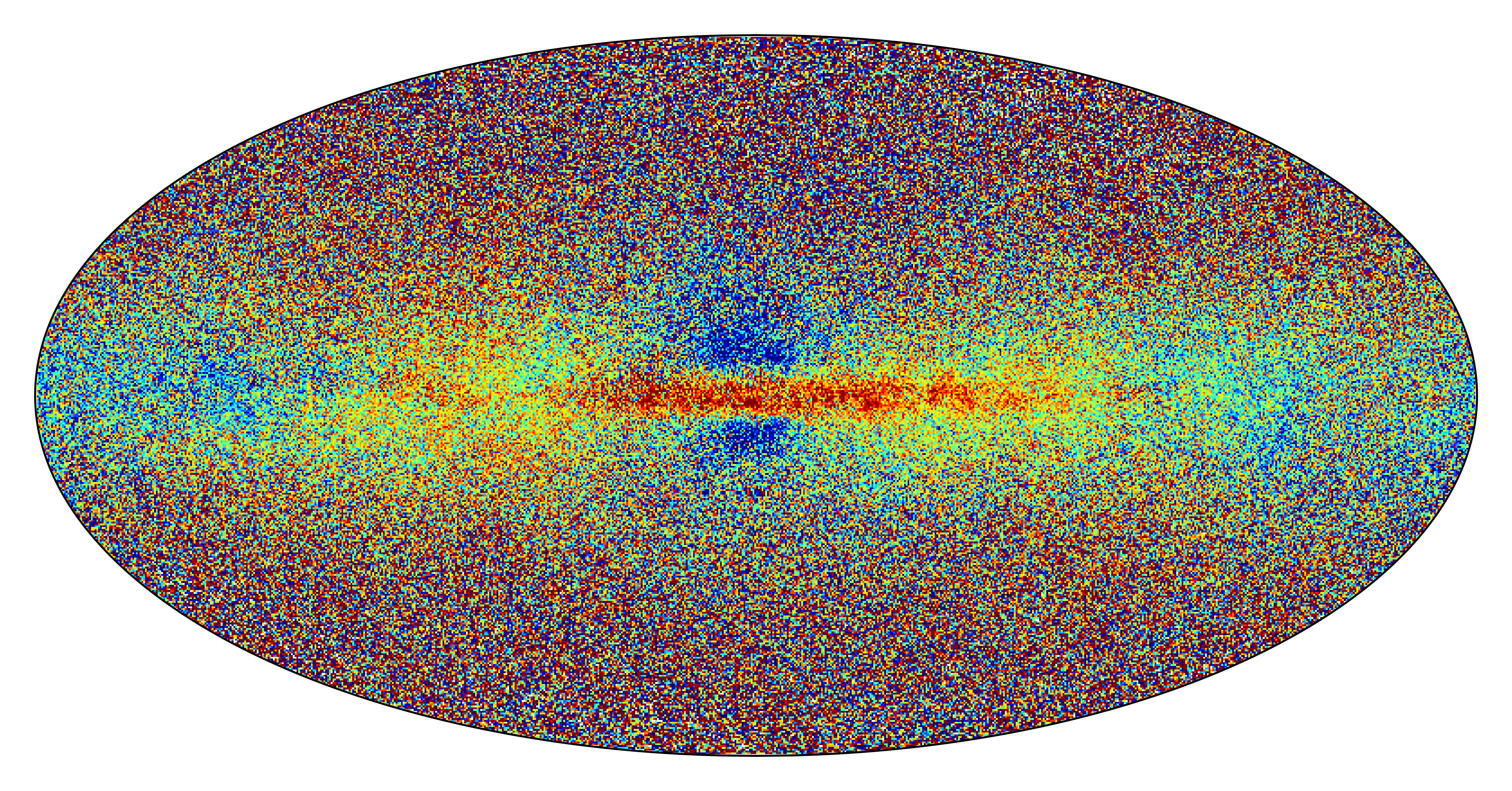
What we’ve been able to infer, from these lines of evidence as well as others, is that the Milky Way experienced several significant merger events over the course of its history: a history that turns out to be rich in cosmic violence.
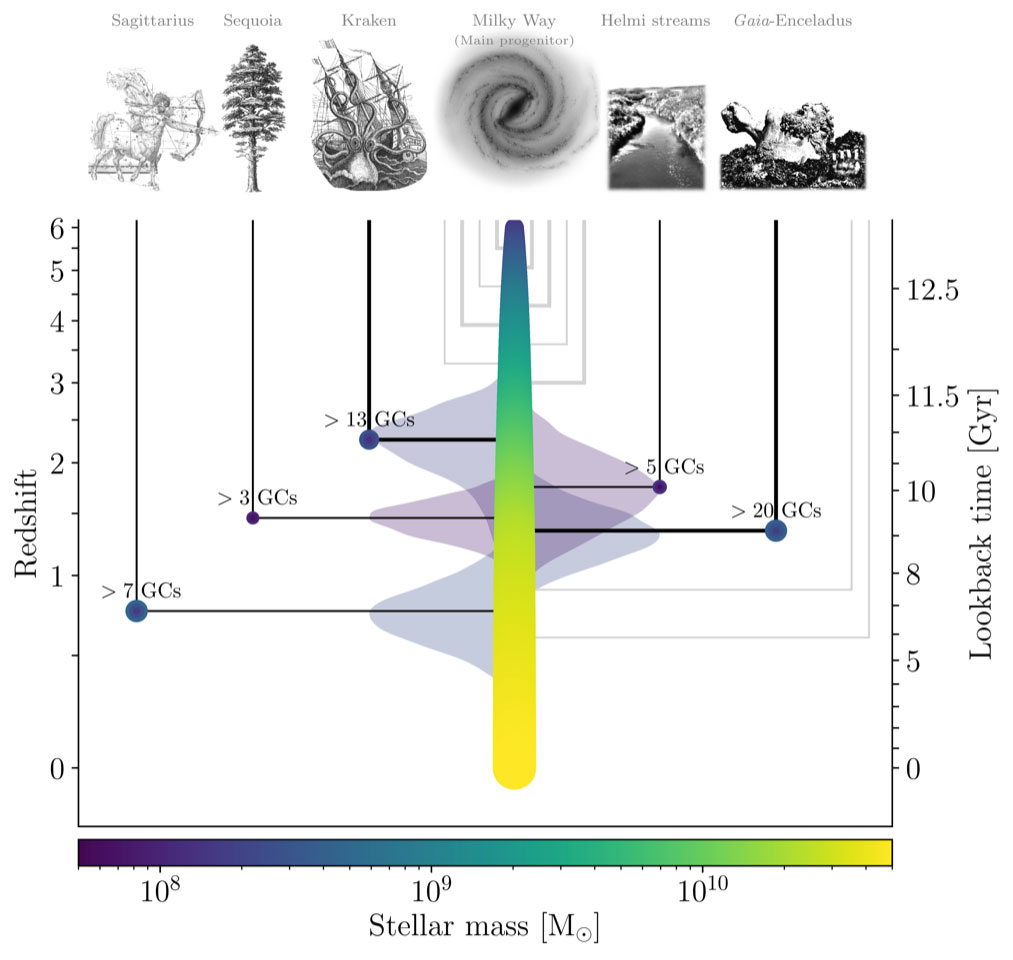
When we take what we’ve learned about the Milky Way through these efforts, we arrive at the realization that the Milky Way didn’t, as was once thought, form from the monolithic collapse of a single, ancient cloud of material. Instead, we find that the seeds for the Milky Way formed long ago: more than 13 billion years ago, back when the Universe was still in its cosmic childhood. As it grew up during our cosmic adolescence, however, there’s strong evidence that well over a dozen separate merger events occurred: where smaller, lower-mass galaxies were cannibalized by the young Milky Way, delivering stars, globular clusters, and reservoirs of gas and dust to our cosmic home.
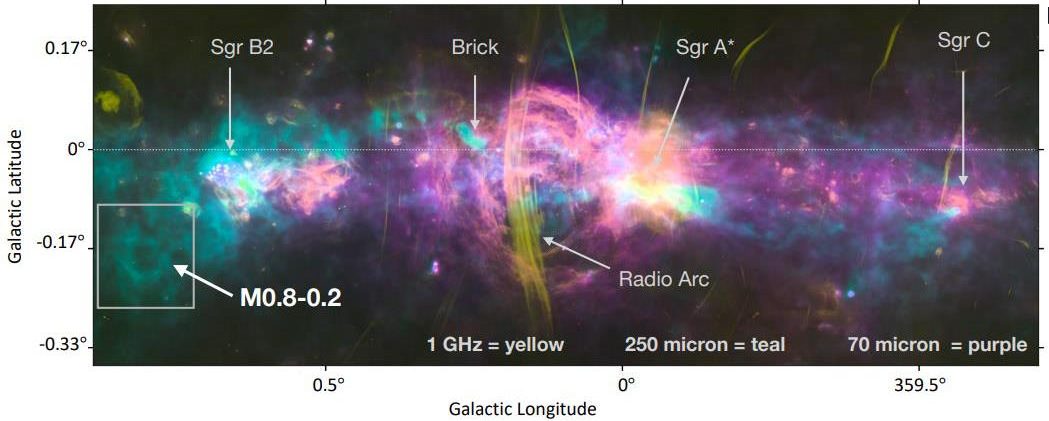
We can even conduct surveys in long wavelengths of light, such as infrared light, where we peer through the dust-rich plane of the Milky Way and reveal the stars and other material present in our central bulge and disk. Inside, we can find all sorts of features, like filaments of heated material, collimated ions following magnetic field lines, and evidence of energy and matter transport within just a few degrees of the galactic center: evidence for interactions between galactic matter and the central black hole. Even though we only have a single snapshot of the Milky Way as we see it today, all of this evidence helps enable us to construct a rich, detailed history, albeit with uncertainties, for how our galaxy formed, grew up, and evolved.
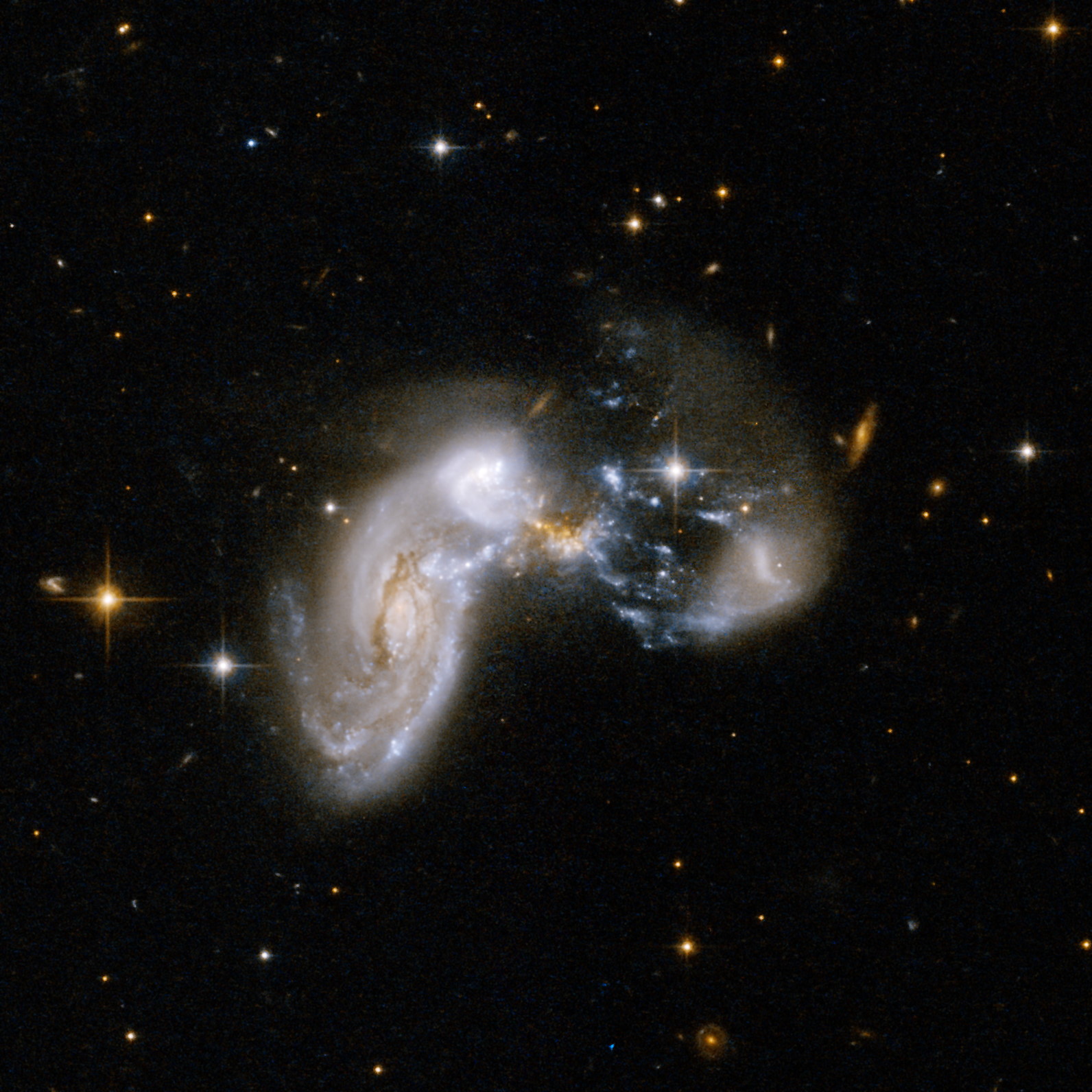
This is bolstered by recent observations of the distant Universe with observatories like ALMA, Hubble, and JWST, which have discovered enormous numbers of galaxies of a variety of masses, in a wide range of environments (some in isolation, some in groups, others in clusters), and in various stages of mergers and/or interactions with nearby galaxies as well. We learned that many of our assumptions about stellar migration were incorrect, and acquired enough snapshots of galaxies in the process of merging to observe what types of tails and streams emerge from systems that interact dependent on the mass ratios of the two merging galaxies.
These techniques of measuring the chemical fingerprints of stars and tracing their motion and reconstructing their historical paths has proven so useful that we’ve even successfully, earlier this year for the first time, performed this type of “galactic archaeology” on a galaxy other than our own: for NGC 1365, a double-barred spiral galaxy about 56 million light-years away. When we combine the observational data with our best simulations of galaxy formation and evolution, we start to converge on the likely history of how a galaxy forms, grows up, and evolves: the exact science goal for the field known as galactic archaeology.
No one is mad about the science of what we call galactic archaeology; that’s a bona fide field of astrophysics that’s rapidly maturing, driven by a wide variety of new data sources here in the 21st century. But the name itself, “galactic archaeology,” deserves to be added to the pantheon of astronomical misnomers, as it fundamentally isn’t related to the enterprise of archaeology at all.
Archaeology is fundamentally about human activity and culture. It is evidence-based and artifact-driven, and relates to other fields such as anthropology, history, and geography. Importantly, archaeology often involves the digging up of — or what might be better characterized as a combination of surveying, excavating, and analyzing — physical artifacts that open a window into the past of humans and our hominid ancestors. Archaeology is a vitally important enterprise for learning about prehistoric societies, as they predate written records.
Archaeology literally means “the study of ancient history,” and there’s actually an overlap between astronomy and archaeology: archaeoastronomy. Unlike modern astronomy, archaeoastronomy isn’t necessarily about the study of the sky and the physical objects we see in it, but rather includes cultural interpretations (often lacking any scientific validity) of phenomena visible in the sky, as well as the study of skywatching itself throughout history.

You might argue that using the term “galactic archaeology” is fine, because archaeology is all about digging up fossils and galactic archaeology uses cosmic fossils to inform and trace out a galaxy’s past. But that’s natural history, not human history; the science of digging up fossils from the past is not archaeology at all, but rather the science of paleontology. Unlike archaeology, which studies human history, culture, and civilization through physical artifacts, paleontology is the study of life throughout all of our past history: mainly (but not exclusively) through the study of fossils.
Does this mean paleontology is a better analogy for studying a galaxy’s history than archaeology?
Probably not. Archaeology is the study of humans and human activity and human culture, whereas paleontology is the study of living organisms of all types throughout history: vertebrates, invertebrates, plants, fungi, protists, and simple single-celled life. When we look out at the Universe and measure stars and galaxies, we’re studying none of that: we’re studying inorganic materials inside entities that are of interest in and of themselves. Just as geology is the study of the Earth throughout its history, what we call galactic archaeology and even stellar archaeology are just the study of galaxies and stars throughout their history as well.
“Well, big deal,” you might say, “we have misnomers all the time, and if this is what the people who are doing it are calling it, what right does anyone have to get upset?”
And there’s a point to that line of thought. In terms of mass, formation history, and composition, Pluto has no right to be called a planet, but in terms of the field of planetary science and in discussions of planetary bodies, working scientists refer to Pluto as a planet all the time. So if scientists haven’t been able to come to an agreement about what makes something a planet or not, why should anyone be upset at the use of terms like “stellar archaeology” or “galactic archaeology” to discuss the history and formation of stars and galaxies, whether it be our own or one external to us?
But there’s a strong counterargument that I, personally, find very compelling. If we wanted to know what were the origins of the ingredients and conditions that gave rise to:
- the Sun and Solar System,
- the Earth,
- life on Earth,
- animals on Earth,
- and even hominids and humans on Earth,
that is a story that, on its surface, may seem entirely lost to the annals of history. Our Solar System, Sun, and planet formed some 4.5 billion years ago: when the Universe was just 9.2 billion years old. But if we could somehow learn what the steps that led to us are, and where the ingredients that enabled those steps came from and how they came together to bring us about, that would indeed reflect stellar and/or galactic archaeology and paleontology.
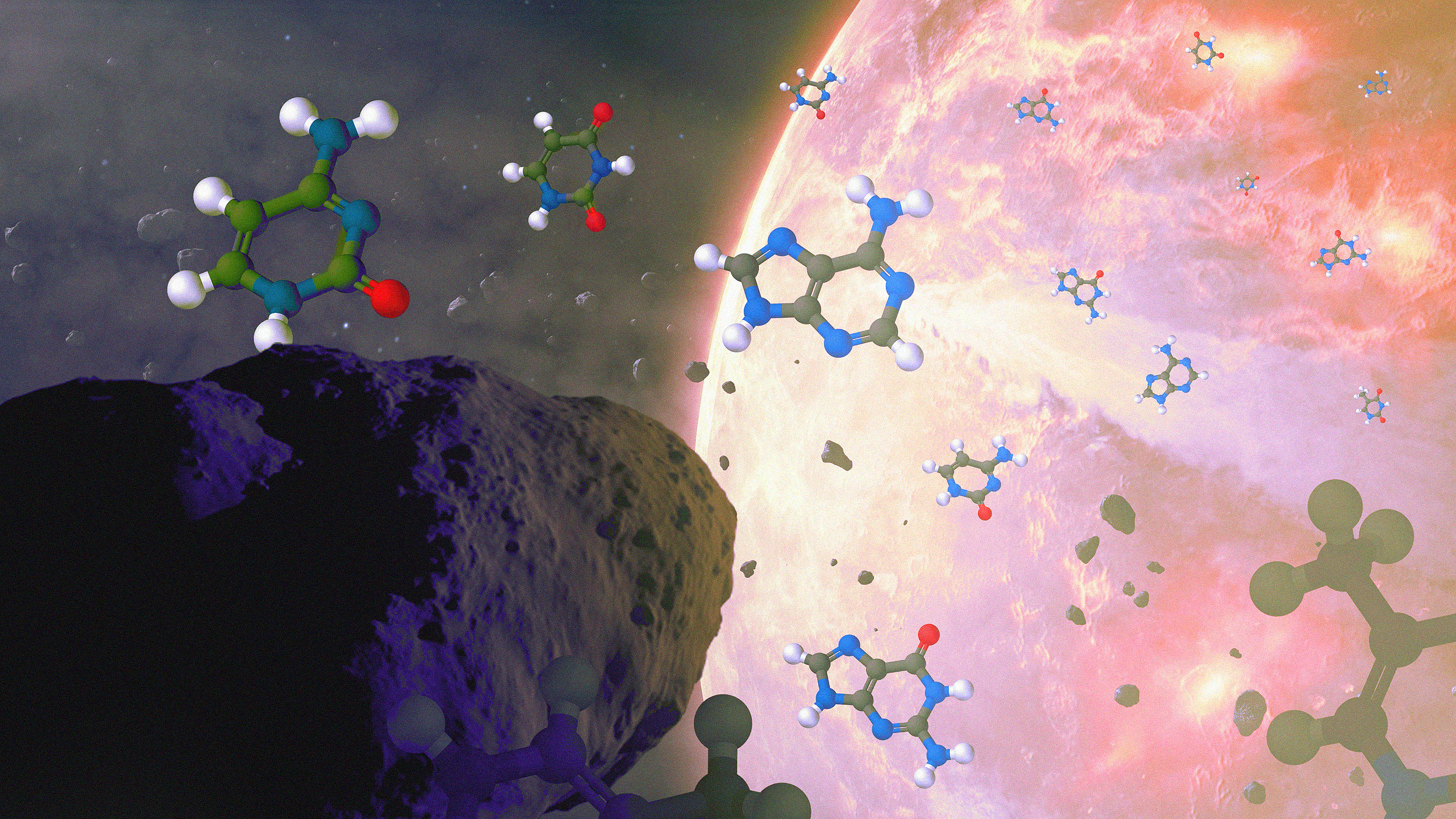
In other words, when science has advanced to a certain point — well-beyond where we are today — we may indeed be able to someday engage in galactic archaeology or galactic paleontology, determining how what occurred in space in the distant past relates to life, and even human life, here on Earth. We could learn about where the cosmic ingredients that not only make up planet Earth, but Earth’s biosphere (the portion of Earth where life exists: the crust, oceans, and atmosphere) originated from. We could, in principle, reconstruct the history of where those ingredients were created, how they were transported to the molecular cloud that formed our Sun, and how the physics of the pre-solar nebula worked to deliver those ingredients to their present location.
We could, perhaps, even reconstruct how the raw ingredients that led to the first emergence of life on our planet formed and wound up in the location(s) where life arose some four billion years ago or so. That would be a link with life, and potentially even a link with humans, representing a true link with the fields of archaeology and paleontology. But at present, that’s not what we’re doing. We’re looking at these objects, tracing out the things we can trace, and trying to learn about their historical properties and how they evolved to be the way they are today. But when you imagine what galactic archaeology could actually someday become, it’s hard to justify using that name for something so thoroughly divorced from the human-focused discipline that defines archaeology in the first place.

The Power of Play