What is Big Think?  

We are Big Idea Hunters…

We live in a time of information abundance, which far too many of us see as information overload. With the sum total of human knowledge, past and present, at our fingertips, we’re faced with a crisis of attention: which ideas should we engage with, and why? Big Think is an evolving roadmap to the best thinking on the planet — the ideas that can help you think flexibly and act decisively in a multivariate world.

A word about Big Ideas and Themes — The architecture of Big Think

Big ideas are lenses for envisioning the future. Every article and video on bigthink.com and on our learning platforms is based on an emerging “big idea” that is significant, widely relevant, and actionable. We’re sifting the noise for the questions and insights that have the power to change all of our lives, for decades to come. For example, reverse-engineering is a big idea in that the concept is increasingly useful across multiple disciplines, from education to nanotechnology.

Themes are the seven broad umbrellas under which we organize the hundreds of big ideas that populate Big Think. They include New World Order, Earth and Beyond, 21st Century Living, Going Mental, Extreme Biology, Power and Influence, and Inventing the Future.

Big Think Features:

12,000+ Expert Videos

1

Browse videos featuring experts across a wide range of disciplines, from personal health to business leadership to neuroscience.

Watch videos

World Renowned Bloggers

2

Big Think’s contributors offer expert analysis of the big ideas behind the news.

Go to blogs

Big Think Edge

3

Big Think’s Edge learning platform for career mentorship and professional development provides engaging and actionable courses delivered by the people who are shaping our future.

Find out more
Close

Why We Hate Waiting in Line
August 19, 2012, 3:01 PM
Standing%20in%20line

What's the Latest Development?

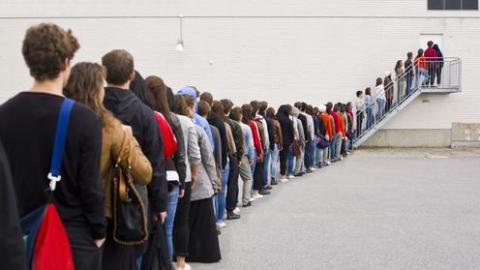
Americans will spend roughly 37 billion hours waiting in lines this year and whether we feel merely inconvenienced or thoroughly frazzled by the wait depends more on our psychology than on any objective measure of time spent waiting. Standing in line for five minutes represents unoccupied time, which people tend to report as lasting longer than the same five minutes of occupied time. In an attempt to alleviate our stress, businesses have responded by occupying us, whether that means placing mirrors in elevators, or tabloids and packets of gum at the grocery store checkout lane.

What's the Big Idea?

Beyond our individual experiences of waiting in line, orderly queues represent an attempt by society to be fair, with those who cut the line subject not only to the ire of people behind them but people in front of them, as well. "A study of fans in line for U2 tickets found that people are just as upset by slips and skips that occur behind them, and thus don’t lengthen their wait, as they are by those in front of them." Our fairness standard also states that waiting time should be proportional to the value of what we are waiting for, which explains the express checkout lane at grocery stores, a rare socially-sanctioned violation of first-come-first-served principle.

Photo credit: Shutterstock.com


Why We Hate Waiting in Line

Newsletter: Share: