Big ideas.
Once a week.
Subscribe to our weekly newsletter.
Russia to replace Wikipedia with the 'Great Russian Encyclopaedia'
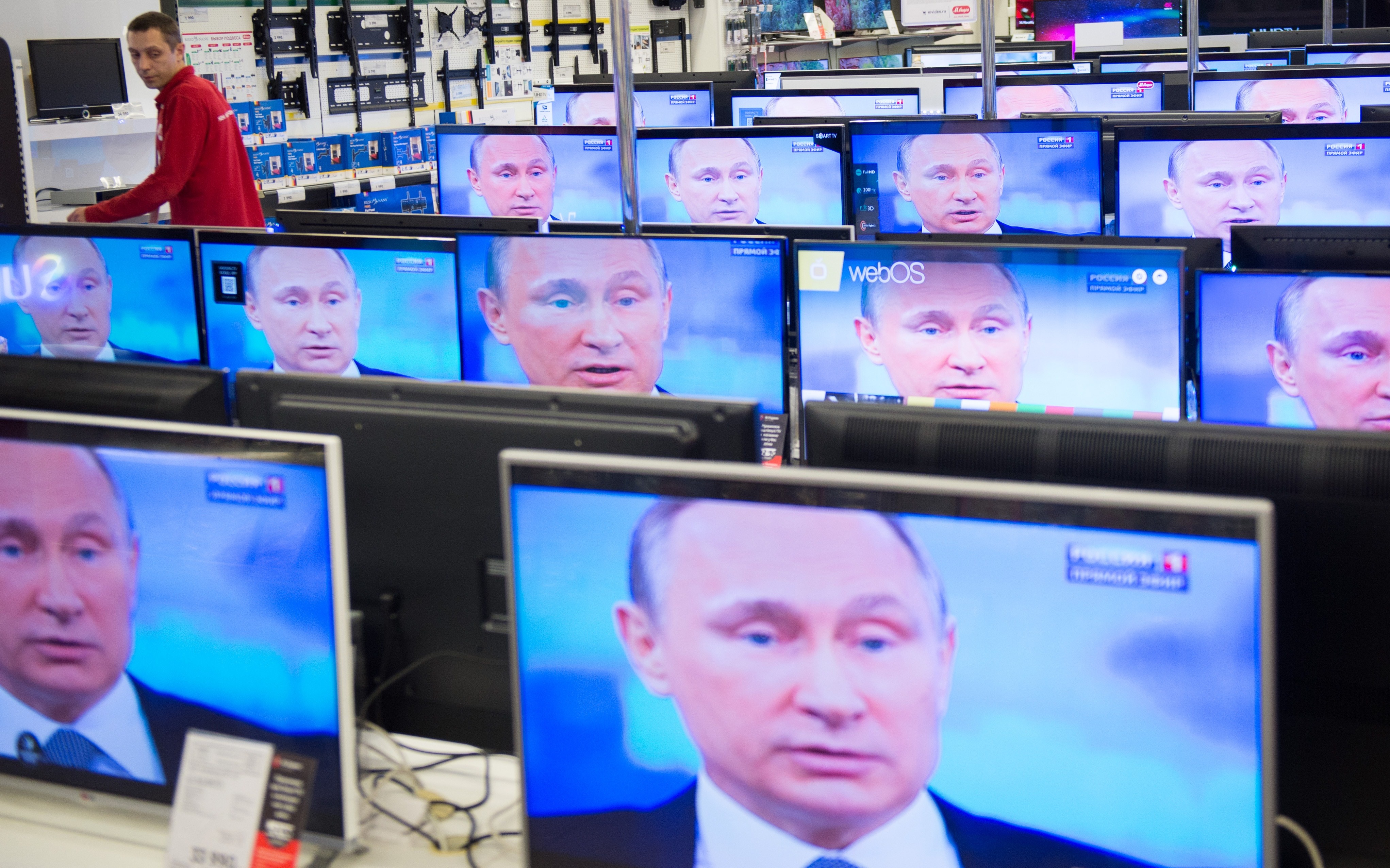
The encyclopedia offers more "reliable" information than Wikipedia, said Russian President Vladimir Putin.
Mikhail Svetlov / Contributor
- A government resolution said the measure will ensure that "reliable information that is constantly updated on the basis of scientifically verified sources of knowledge."
- The move is likely part of Russia's effort to crack down on citizens' internet access.
- Russia has centuries-old history of censorship, and state officials have even been observed to edit Wikipedia articles to serve Russian interests.
Wikipedia is full of unreliable information, Russian President Vladimir Putin said last month. The solution? Replace it with an electronic version of the Great Russian Encyclopaedia, an existing reference work whose content is possibly influenced by the Russian government.
"As for Wikipedia… it's better to replace it with the new Big Russian Encyclopaedia in electronic form," Russian news agency RIA Novosti quoted Putin as saying at a Kremlin meeting in November. "At least that will be reliable information, presented in a good, modern way."
A government resolution said the measure will ensure that "reliable information that is constantly updated on the basis of scientifically verified sources of knowledge."
But upon the launch of encyclopedia's latest iteration, in 2017, writer Nikolai Podosokorsky told the Christian Science Monitor that while some of the pieces featured in the work were "excellent," others were shallow and biased.
"I've gone through several articles that pertain to my area of expertise, and found them quite superficial. The lists of references at the end were often extremely biased."
Of course, the new measure will also help Russia crack down even harder on citizens' internet access, a longstanding project of the Kremlin. In 2017, Russia said it plans to route 95 percent of internet traffic through its own servers by 2020. Earlier this year, Russia conducted an experiment in which it briefly disconnected itself from global servers to test how well it functioned on its self-contained internet. The test seemed designed, in part, to bolster safeguard measures in the event that Russia was attacked in an act of cyber warfare.

But it's also possible that Russia is exploring new ways to make its internet even more censored, surveilled and isolated from outside influence. In March, for example, Russia passed legislation banning the publication of "unreliable socially significant information" and content that shows "clear disrespect" for the government. Under this law, multiple people were fined for sharing a video about the lack of schools in a province of Russia, according to a report from the Russian media freedom watchdog Roskomsvoboda.
Why Russia dislikes Wikipedia
Maybe it's no wonder why Russia wants to axe Wikipedia, a crowd-sourced website that currently hosts entries like "Internet censorship in Russia", "List of journalists killed in Russia" and "Propaganda in the Russian Federation". Putin's own Wikipedia page mentions accusations that Putin had elections rigged and his critics tortured and murdered. It also has a section titled "Comparison to Hitler."
There's also a Wikipedia entry for Malaysia Airlines Flight 17, which was shot down over a part of Ukraine occupied by pro-Russian separatists in 2014. That same year, a Twitter bot that monitors edits made to Wikipedia pages found that an internet user affiliated with Russian state media changed the following sentence:
The plane was shot down by terrorists of the self-proclaimed Donetsk People's Republic with Buk system missiles, which the terrorists received from the Russian Federation.
To:
The plane was shot down by Ukrainian soldiers.
This year, international investigators accused four pro-Russian military officials of being involved in the attacks.
Centuries of censorship
Russia's history of vying to maintain top-down information control at all costs dates back to the 18th century. And it makes sense, from the perspective of the few in control: The state would lose power if it's unable to control how citizens access and share information, as Niall Ferguson, MA, D.Phil., Milbank Family Senior Fellow at the Hoover Institution, told Big Think.
"[Stalin] understood that it doesn't take too many additional edges in the network to destroy the dominance of that central node. So one way of thinking about this is: imagine a pyramidal structure, imagine something kind of like a Christmas tree, and there's the big guy like the fairy on top of the Christmas tree. But imagine that on this Christmas tree the lights are just connected to the fairy, they're not connected to one another, and therefore the fairy decides if the lights go on or off. It's a peculiar kind of Christmas tree. That's essentially a hierarchical network.
It wouldn't take too many connections, as it were—lateral or horizontal connections—between the lights to reduce the centrality of the fairy on the tree, and ultimately you could end up illuminating the tree without needing the fairy altogether."
Impossible cosmic rays are shooting out of Antarctica
No particle we know of can explain what's going on.
- Cosmic rays have been discovered coming out of Antarctica.
- No high-speed particle we know of could possibly go in one side of the earth and come out the other.
- All of the proposed explanations are exciting, especially the most likely one.
Meet ANITA. ANITA stands for "Antarctic Impulsive Transient Antenna." It seeks out cosmic rays from space as while hanging from a balloon suspended over Antarctica. In the last two years, though, it has twice detected cosmic rays coming from a direction no one expected: inside the earth. According to the Standard Model (SM) of physics, this shouldn't be possible.

And guess what? ANITA’s not alone
In September, a paper was submitted for peer review by astrophysicists at Penn State led by Derek Fox. "I was like, 'Well this model doesn't make much sense,'" Fox tells Live Science, "but the [ANITA] result is very intriguing, so I started checking up on it. I started talking to my office neighbor [and paper co-author] Steinn Sigurdsson about whether maybe we could gin up some more plausible explanations than the papers that have been published to date." Lacking any, they looked for other similar events and found three. They'd been detected by a surface-based Antarctic neutrino detector called, sensibly enough, IceCube. And when the data from ANITA and IceCube when combined, the Penn State scientists started getting excited. They calculate that whatever kind of particle is flying up and away from Earth has a less than 1-in-3.5 million chance of being any of the particles predicted by the Standard Model. Obviously, this has physicists scratching their heads trying to figure out what on earth is going on.

IceCube
How cosmic rays are supposed to behave
First of all, of course, cosmic rays are supposed to come from out there somewhere, not here. The earth is bombarded with them all the time. The suspicion is that the newly detected particles are cosmic rays slamming into the earth on one side and somehow making it out the other.
Cosmic rays, though, are high-energy particles with relatively wide cross-sections that lead to their demise by causing them to crash into matter inside the Earth. They're "mainly (89%) protons — nuclei of hydrogen, the lightest and most common element in the universe — but they also include nuclei of helium (10%) and heavier nuclei (1%), all the way up to uranium particles," according to CERN. Low-energy neutrinos, on the other hand, can pass through the earth's rocky mass, but they're not involved with cosmic rays.
Both ANITA and IceCube track neutrinos indirectly by detecting their remains, if you will. They detect the particles neutrinos produce when they decay post-collision. Since neutrinos can't get through the earth, though, something else is producing these particles. But what?

Artist rendition of cosmic rays
(koya979/Shutterstock)
They could be a new kind of particle…
One candidate put forward as responsible for the event is the elusive "sterile neutrino," first hinted at by evidence captured in the mid 1990s at the Liquid Scintillator Neutrino Detector (LSND) at Los Alamos. The data was interpreted as suggesting a weird kind of high-speed neutrino that simply passes through matter without any interaction. No one else was able to reproduce the result, and the idea fell out of favor. Until this last spring, that is, when MiniBooNE at Chicago's FermiLab captured new signs that it might exist. The sterile neutrino would break the Standard Model if confirmed, which is one of the things that make MiniBoonE's data exciting. "That would be huge," says Duke physicist Kate Scholberg, who wasn't involved with the research, "…that would require new particles ... and an all-new analytical framework."
Others have suggested that it could be a product of dark matter. Cool as either of these ideas would be, perhaps the strongest reason for the detected upward cosmic rays is even more thrilling.
…or they could be long-sought supersymetrical particles
According to the Standard Model, every particle has a symmetrical partner, but the particles we know about don't match up. To resolve this apparent imbalance, a class of thus-far-hidden "supersymmetrical" particles has been proposed. It was hoped that the Large Hadron Collider could detect these mysterious — and so far just theoretical — particles, but no. Since 2012, when the last known particle predicted the Standard Model, the Higgs-Boson, was detected, nothing new's been found.
Until, maybe, now.
What the Penn paper proposes
The Penn State paper suggests these South Pole upward cosmic rays could be our first sign of supersymmetricals, specifically the partner of the Standard Model's tau leptons. With a a couple of "S"es added to signify supersymmetry, they'd be stau sleptons.
Others agree that they could be the first actual evidence of supersymmetry. Los Alamos physicist Bill Louis tells LiveScience, "I think it's very compelling," though he adds that the pinpointing of a stau slepton is "a bit of a stretch."
Fox admits he certainly can't be sure, but that, "From my perspective, I go trawling around trying to discover new things about the universe, I come upon some really bizarre phenomenon, and then with my colleagues, we do a little literature search to see if anybody has ever thought that this might happen. And then if we find papers in the literature, including one from 14 years ago that predict something just like this phenomenon, then that gets really high weight from me." And, guess what, he did find a prediction from 2003 of stau sleptons showing up just like this.
Researchers identify genes linked to severe repetitive behaviors
A lab identifies which genes are linked to abnormal repetitive behaviors found in addiction and schizophrenia.
These behaviors, termed stereotypies, are also apparent in animal models of drug addiction and autism.
In a new study published in the European Journal of Neuroscience, researchers at the McGovern Institute for Brain Research have identified genes that are activated in the brain prior to the initiation of these severe repetitive behaviors.
"Our lab has found a small set of genes that are regulated in relation to the development of stereotypic behaviors in an animal model of drug addiction," says MIT Institute Professor Ann Graybiel, who is the senior author of the paper. "We were surprised and interested to see that one of these genes is a susceptibility gene for schizophrenia. This finding might help to understand the biological basis of repetitive, stereotypic behaviors as seen in a range of neurologic and neuropsychiatric disorders, and in otherwise 'typical' people under stress."
A shared molecular pathway
In work led by Research Scientist Jill Crittenden, scientists in the Graybiel lab exposed mice to amphetamine, a psychomotor stimulant that drives hyperactivity and confined stereotypies in humans and in laboratory animals and that is used to model symptoms of schizophrenia.
They found that stimulant exposure that drives the most prolonged repetitive behaviors led to activation of genes regulated by Neuregulin 1, a signaling molecule that is important for a variety of cellular functions including neuronal development and plasticity. Neuregulin 1 gene mutations are risk factors for schizophrenia.
The new findings highlight a shared molecular and circuit pathway for stereotypies that are caused by drugs of abuse and in brain disorders, and have implications for why stimulant intoxication is a risk factor for the onset of schizophrenia.
"Experimental treatment with amphetamine has long been used in studies on rodents and other animals in tests to find better treatments for schizophrenia in humans, because there are some behavioral similarities across the two otherwise very different contexts," explains Graybiel, who is also an investigator at the McGovern Institute and a professor of brain and cognitive sciences at MIT. "It was striking to find Neuregulin 1 — potentially one hint to shared mechanisms underlying some of these similarities."
Drug exposure linked to repetitive behaviors
Although many studies have measured gene expression changes in animal models of drug addiction, this study is the first to evaluate genome-wide changes specifically associated with restricted repetitive behaviors.
Stereotypies are difficult to measure without labor-intensive direct observation, because they consist of fine movements and idiosyncratic behaviors. In this study, the authors administered amphetamine (or saline control) to mice and then measured with photobeam-breaks how much they ran around. The researchers identified prolonged periods when the mice were not running around (i.e., were potentially engaged in confined stereotypies), and then they videotaped the mice during these periods to observationally score the severity of restricted repetitive behaviors (e.g., sniffing or licking stereotypies).
They gave amphetamine to each mouse once a day for 21 days and found that, on average, mice showed very little stereotypy on the first day of drug exposure but that, by the seventh day of exposure, all of the mice showed a prolonged period of stereotypy that gradually became shorter and shorter over the subsequent two weeks.
"We were surprised to see the stereotypy diminishing after one week of treatment. We had actually planned a study based on our expectation that the repetitive behaviors would become more intense, but then we realized that this was an opportunity to look at what gene changes were unique to that day of high stereotypy," says first author Jill Crittenden.
The authors compared gene expression changes in the brains of mice treated with amphetamine for one day, seven days, or 21 days. They hypothesized that the gene changes associated specifically with high-stereotypy-associated seven days of drug treatment were the most likely to underlie extreme repetitive behaviors and could identify risk-factor genes for such symptoms in disease.
A shared anatomical pathway
Previous work from the Graybiel lab has shown that stereotypy is directly correlated to circumscribed gene activation in the striatum, a forebrain region that is key for habit formation. In animals with the most intense stereotypy, most of the striatum does not show gene activation, but immediate early gene induction remains high in clusters of cells called striosomes. Striosomes have recently been shown to have powerful control over cells that release dopamine, a neuromodulator that is severely disrupted in drug addiction and in schizophrenia. Strikingly, striosomes contain high levels of Neuregulin 1.
"Our new data suggest that the upregulation of Neuregulin-responsive genes in animals with severely repetitive behaviors reflects gene changes in the striosomal neurons that control the release of dopamine," Crittenden explains. "Dopamine can directly impact whether an animal repeats an action or explores new actions, so our study highlights a potential role for a striosomal circuit in controlling action-selection in health and in neuropsychiatric disease."
Patterns of behavior and gene expression
Striatal gene expression levels were measured by sequencing messenger RNAs (mRNAs) in dissected brain tissue. mRNAs are read out from "active" genes to instruct protein-synthesis machinery in how to make the protein that corresponds to the gene's sequence. Proteins are the main constituents of a cell, thereby controlling each cell's function. The number of times a particular mRNA sequence is found reflects the frequency at which the gene was being read out at the time that the cellular material was collected.
To identify genes that were read out into mRNA before the period of prolonged stereotypy, the researchers collected brain tissue 20 minutes after amphetamine injection, which is about 30 minutes before peak stereotypy. They then identified which genes had significantly different levels of corresponding mRNAs in drug-treated mice than in mice treated with saline.
A wide variety of genes showed modest mRNA increases after the first amphetamine exposure, which induced mild hyperactivity and a range of behaviors such as walking, sniffing, and rearing in the mice.
By the seventh day of treatment, all of the mice were engaged for prolonged periods in one specific repetitive behavior, such as sniffing the wall. Likewise, there were fewer genes that were activated by the seventh day relative to the first treatment day, but they were strongly activated in all mice that received the stereotypy-inducing amphetamine treatment.
By the 21st day of treatment, the stereotypy behaviors were less intense, as was the gene upregulation — fewer genes were strongly activated, and more were repressed, relative to the other treatments. "It seemed that the mice had developed tolerance to the drug, both in terms of their behavioral response and in terms of their gene activation response," says Crittenden.
"Trying to seek patterns of gene regulation starting with behavior is correlative work, and we did not prove 'causality' in this first small study," explains Graybiel. "But we hope that the striking parallels between the scope and selectivity of the mRNA and behavioral changes that we detected will help in further work on the tremendously challenging goal of treating addiction."
This work was funded by the National Institute of Child Health and Human Development, the Saks-Kavanaugh Foundation, the Broderick Fund for Phytocannabinoid Research at MIT, the James and Pat Poitras Research Fund, The Simons Foundation, and The Stanley Center for Psychiatric Research at the Broad Institute.
Reprinted with permission of MIT News. Read the original article.
The Christian church so holy that Muslims hold its keys
Six denominations share the Holy Sepulcher, but not all between them is peace and love.
An Armenian priest circles the Edicule, which marks the place where tradition holds Jesus was buried. The structure is located straight under the dome of the Church of the Holy Sepulchre in Jerusalem.
- The Church of the Holy Sepulcher is not just the holiest site in Christianity; it is also emblematic of the religion's deep divisions.
- As the map below shows, six denominations each control part of the church, with only some parts held in common.
- Each "territory" is jealously guarded and sometimes fought over. The church's keys are held by… two Muslim families.

On a ledge over a church door in Jerusalem stands a simple cedarwood ladder. It's been there for perhaps three centuries. Since nobody remembers who put it there, nobody knows who is authorized to remove it. If anyone would try, there'd be immediate trouble with whomever would feel slighted — and there are plenty of candidates. This is the Immovable Ladder, and it is a fitting symbol for the deeply-entrenched divisions within Christianity, and within that church building itself.
The most sacred place on Earth
Those religious divides matter here more than anywhere else because this is the most significant church in the world. For Christians of any denomination this is the most sacred place on Earth. This is the Church of the Holy Sepulcher, and according to tradition, it contains both Golgotha (or Calvary in Latin; both mean "skull"), the place where Jesus died on the cross. Just a few feet further is the tomb (a.k.a. sepulcher) where his body was laid to rest and where according to the faithful he was resurrected three days later.
Yet despite its supreme religious importance, there is no single authority managing this holiest of church buildings. The care over the sprawling, multi-level complex is divided between various denominations.
The church's history goes back to the fourth century, when Roman emperor Constantine, newly converted to Christianity, sent his mother Helena to Jerusalem to locate places and things associated with the life and death of Jesus. This is the spot where she found the True Cross, a sign that this must have been Golgotha. The place of Jesus' burial was identified nearby. Constantine razed the pagan temple built here by his predecessor Hadrian, and a church on this spot, the first commissioned by a Roman emperor, was consecrated in the year 335.
In continuous use for 1700 years
The church has survived earthquakes, fires, invasions, and demolition by decree. It has been in continuous use for nearly 1700 years, even if the building standing there today is mostly a renovation and reconstruction dating to Crusader times. Over the centuries, various Christian traditions latched on to the church. Ownership became a constant source of dispute.
In 1852, the Ottoman Sultan decreed that the church was to be managed by the Greek Orthodox, Roman Catholic, and Armenian Apostolic churches and apportioned parts of the building to each denomination. Over time, smaller parts of the building came under the authority of three smaller Orthodox denominations: the Coptic, Syriac, and Ethiopian churches.

- Most of the building is under control of the Greek Orthodox church (in blue on the map). They manage the Katholikon (which is slightly ironic), the North Transept, the Seven Arches of the Virgin, a small Orthodox monastery, and various chapels, among other bits.
- The Latins (a.k.a. Roman Catholics, in purple) manage the Franciscan Monastery on the north side (which includes the Chapel of the Apparition and the Chapel of Mary Magdalene), the Grotto of the Invention of the Cross, a small area north of the Parvis, and a tiny space between the Katholikon and the Rotunda.
- The Armenians (in yellow) manage the Chapel of St. Helena, the Chapel of St. James, and the Armenian Gallery next to the Rotunda.
- The Copts (in red) have the care of various chapels near the Rotunda, including a small annex to the Edicule (i.e., the Holy Sepulcher) itself.
- The Ethiopian monastery is spread out on the roof, and the Ethiopians also manage an area called Deir al-Sultan, the Chapel of the Four Living Creatures, and the Chapel of St. Michael (all in orange).
- The Syriac church has the smallest part (in green): the Chapel of St. Nicodemus. But at least it's very close to the Sepulcher.
The Ottoman edict is the basis for the status quo, which is scrupulously maintained. A complex set of rules determines how the church is managed — such as who is allowed where and when, who cleans and repairs which parts of the building, and which areas are held in common (by the Greeks, Latins, and Armenians but not by the other three).
- The Rotunda is common territory, as is a chapel to the north.
- The Parvis (i.e. the courtyard at the entrance) is also common, as is an adjacent part of the church that contains the Stone of Unction (where according to tradition, Jesus' body was prepared for burial).
But some of the rules are disputed, and conflicts occasionally erupt. Two examples:
- The Copts have a long-standing claim over part of the roof, which is occupied by Ethiopian monks. To maintain their claim, Coptic monks take turns to sit on a chair on the roof. But on a particularly hot day in 2002, when a Coptic monk moved the chair a few inches into the shade, the Ethiopians interpreted that move as a violation of the status quo. The ensuing fight sent 11 monks to the hospital.
- And in 2008, Greek and Armenian monks got into a violent argument over the procedure of a religious procession. The brawl was caught on camera and pasted all over the news.
Can't we all just get along?
In recent years, however, the churches seem to be getting along a little bit better, although partly out of necessity. Significant parts of the building are in extreme need of repair. In 2017, the three main denominations (Catholic, Greek, and Armenian) agreed to fix the Edicule, which was in danger of collapsing. And in 2019, the three churches signed an agreement to renovate parts of the church's infrastructure (floor, foundations, and sewage pipes) and even to share ownership of any archaeological artifacts that might turn up during the work. However, the agreement excludes the three other denominations, which under the status quo have no say in the management of shared spaces.
Which brings us back to the Immovable Ladder. Despite its nickname, it has proven to be very movable indeed. It was stolen twice in the 20th century. Both times, it was soon recovered by the police and returned to its original position. In 2009, it was moved again, this time with the agreement of all relevant denominations, in order to accommodate scaffolding for renovations.
Upon completion of the works, it was again put back. And there it will remain until, as Pope Paul VI suggested in 1964, the divisions between the various Christian denominations are resolved. Or until Christ returns — whichever happens first.
Meanwhile, the keys to the church building itself will remain where they have been for centuries: in the possession of the Joudeh and Nuseibeh families, who by virtue of their Muslim faith are accepted by all Christian denominations as neutral guardians of the entrance to the church.
Strange Maps #1081
Got a strange map? Let me know at strangemaps@gmail.com.
From the bowels of the earth to the sky: Rethinking civilization growth
A revolution of the mind must occur in order for humanity to succeed on a finite planet.