In our quest to understand what’s out there in the Universe, one cosmic unknown looms larger than all the rest: are there other examples of life, complex life, intelligent life, and technologically advanced life out there beyond planet Earth? And if there are other examples out there, a slew of follow-up questions seem inevitable.
- How common, uncommon, or rare are those types of life?
- Are there other technologically advanced, or even spacefaring, civilizations out there, perhaps even within our own Milky Way?
- Where, and under what conditions, have other forms of life arisen?
- Are the chemical and biological pathways that life took on Earth universal, and if not, what are the variations that are out there?
- And is life on Earth the pinnacle of what life in the Universe can become, or are there even grander examples of biological (or technological) success out there, perhaps for us to learn from as well?
It was only a short while ago that I took stock of where we are today — and where we’d like to go in the near future — in the search for extraterrestrial life in the Universe. And if you think about the issues surrounding what we know today and what we’d love to find out in the near future, it might lead you to ask some big, profound questions about what’s out there. Here are 10 truly excellent ones, and the best answers we know how to give to them today.

1.) If abiogenesis were a common phenomenon, then why didn’t it happen twice (or more) here on Earth?
Abiogenesis, for the uninitiated, is the science of life arising from non-life. When we look at all of the life forms we have record of ever existing on Earth, we can — quite remarkably — trace it all back to what we call LUCA: the Last Universal Common Ancestor of all life that exists today. All extant life evolved from that same population of organisms, at least 3.5 billion years ago and maybe far closer to the initial formation of Earth than that.
But that does not, in any way, imply that life only arose once on Earth. It only implies that, regardless of how many times life did arise on Earth throughout our planet’s history, including whether:
- life arose, and was wiped out, once or even many times over, before “sticking” on Earth,
- many forms of life arose and thrived, coexisting for a while, until one won out over the others,
- or many forms of life arose and evolutionarily converged, mixing together to create the life that survives today,
- or that abiogenesis doesn’t happen frequently, but existing life, with such a long track record, can easily drive it to extinction,
there was one population, at some point, that out-competed all of the others, and persisted even when the others did not. The fact that all life on Earth today can be traced back to a common ancestor doesn’t mean that abiogenesis only happened once on our planet. It simply means that, today, we only have records of the ultimate survivors.
2.) Can we, or do we, entertain the possibility of life without water out there in the Universe?
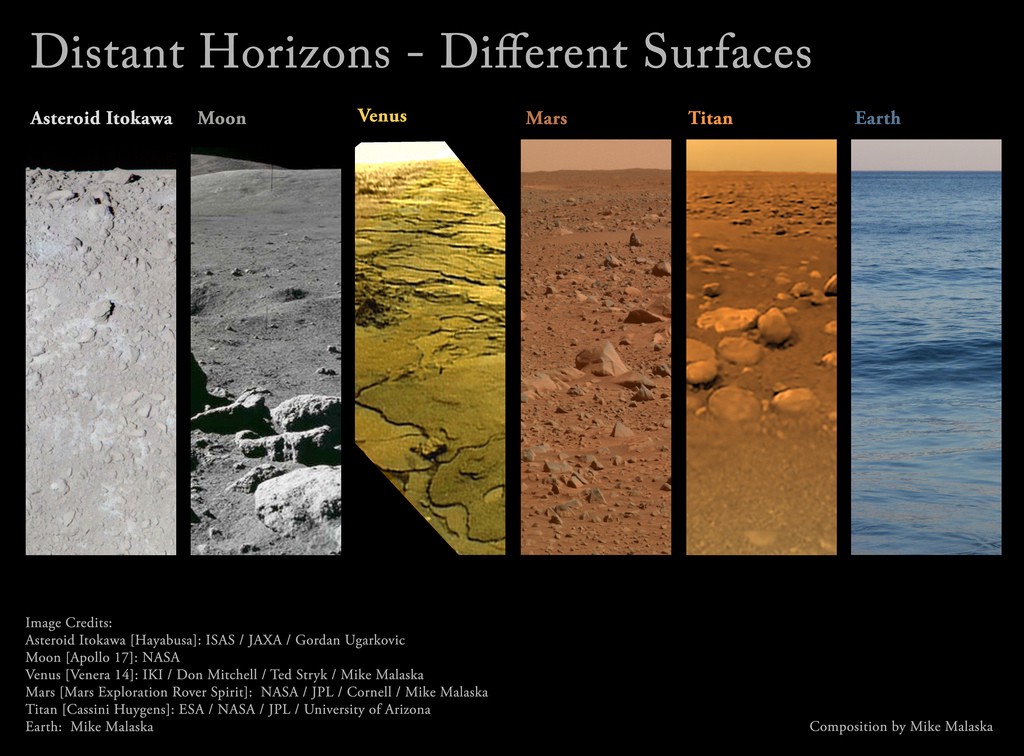
Water, at least here on Earth, is essential to life. Chemically, we often call water the “universal solvent,” because of how good it is at dissolving ions, salts, and many other chemical compounds. (Some compounds, of course, are not water-soluble, such as fats and oils.) All forms of life found on our planet use liquid water in one form or another, and water is incredibly abundant in the Universe: it’s made of two hydrogen and one oxygen atom bound together, and hydrogen and oxygen are the first and third most abundant elements in the cosmos.

But there are other possibilities too, and yes, we do consider them. You could, for example:
- have other solvents, such as formamide, which are excellent at removing water from compounds and helping synthesize organic molecules,
- have mineral surfaces that get “splashed” with some form of liquid, not necessarily water, that enable chemical synthesis that leads to organic processes,
- have the iron-sulfur world scenario, which could lead to life originating in environments too hot for liquid water to persist,
along with several other alternative abiogenesis pathways and scenarios. Since we now know of worlds with liquid oceans other than water, like Titan with liquid methane and Pluto with liquid alcohols and liquid ammonia (perhaps in addition to water), these scenarios frequently are considered as well, including by being supported with laboratory experiments here on Earth.

3.) We know of over 6000 exoplanets, but there are thousands more “candidate exoplanets” out there; how do we promote a candidate to a verified, confirmed exoplanet?
The most common way to find an exoplanet, at least as of 2026, is to observe what we call a planetary transit: where an object passes in front of a parent star, blocking a fraction of its light temporarily. That leads to a dimming of the light from the star, enabling us to infer the presence of a planet.
Well, not quite: of a candidate planet. If that dimming doesn’t recur, then it’s possible that it wasn’t a planet at all, but rather a foreground object unrelated to the parent star entirely. Even if the dimming does recur, and does so periodically, it could be due to:
- an eclipsing binary star system, rather than a planetary transit,
- a brown dwarf star, rather than a planet, transiting in front of the parent star,
- or a single deep, dark sunspot on the star, rotating into-and-out-of view as the star spins relative to our line-of-sight.
To rule these things out, and to confirm a planet, we typically need a second method: the radial velocity (or stellar wobble) method, enabling us to not just estimate the size and period of (what we assume is) an orbiting object, but its mass as well. Only with two separate methods indicating, independently as well as together, that there’s a planet there can we confirm its detection.
4.) Hang on: did you just say that the original Drake equation is based on the Steady-State Model, and not on the Big Bang? What’s up with that?
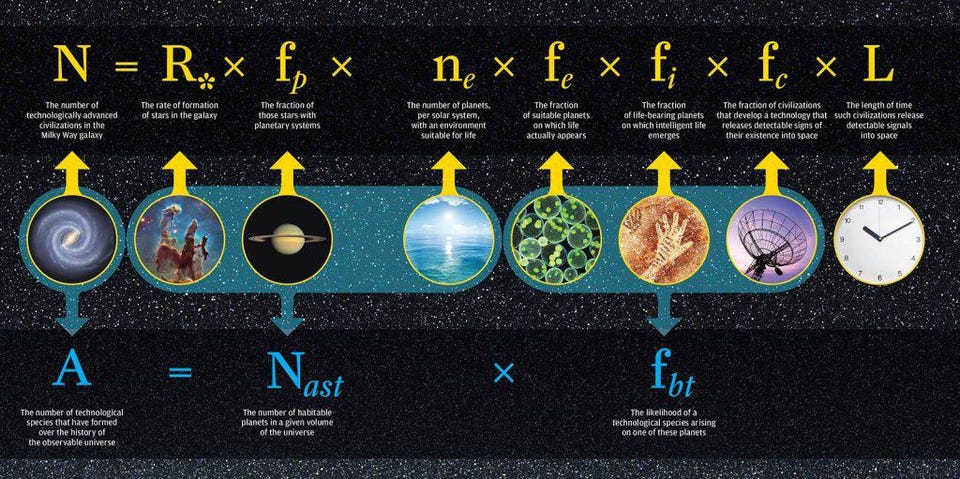
I did say that, and that’s because it’s true. Frank Drake put forth his equation years before the discovery of the cosmic microwave background: the “smoking gun” evidence that confirmed the Big Bang and disfavored the other leading alternatives. In his original equation, he assumed that the Universe was infinitely old, and therefore to estimate the number of habitable planets, you need to know the (he assumed, constant) rate of star-formation in the Universe and the potentially habitable durations of worlds surrounding them.
That’s not the best way to approach the problem of estimating the number of habitable (or inhabited) worlds today, to the best of our knowledge. We instead can:
- take a direct census of stars in our galaxy,
- measure the age of the Universe and calculate the star-formation rate (and how it evolves) over time,
- and measure which types stars have planets and what the frequency of planets (and planet types) are around stars with all sorts of varying properties.
Those quantities, which aren’t just measurable, but now have been accurately measured, give us values for the number of potentially habitable planets in the Milky Way, the local Universe, and the entire observable Universe.
5.) How do theories of scientific realism and instrumentalism affect interpretations of anomalous signals? Could alien intelligence exist outside current scientific detection frameworks?
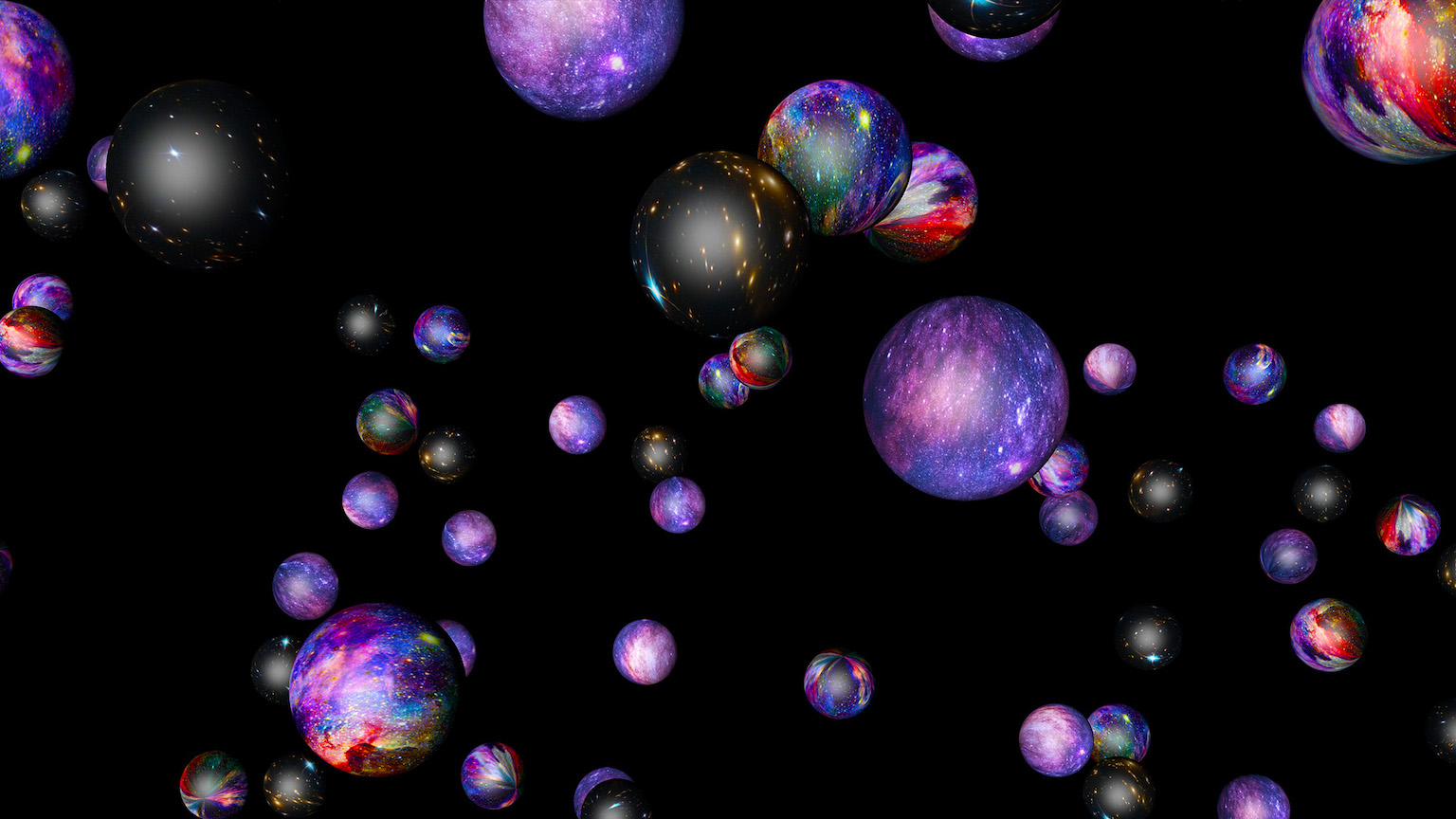
This is, and perhaps always will be, a limitation that’s fundamental to science. We can only base our scientific conclusions about reality, ultimately, on what’s observable, measurable, and verifiable within our Universe. The multiverse may exist beyond our cosmic horizon, extra dimensions may exist at scales where current physics cannot probe, and a physical singularity may exist within every black hole; there are many reasons, theoretically, to strongly suspect that these things are ultimately true.
But because we cannot gather observable, measurable evidence that supports these claims, it’s going to be difficult to draw definitive conclusions about them. The same is true about anything — including an undetectable form of alien intelligence — that exists outside of the framework of scientific detection. It is what separates science in general and physics in particular, which is inherently about the study of the natural world, from metaphysics and the supernatural, which we can only philosophize about. Until and unless we become able to scientifically probe whatever scenario you can concoct, these non-scientific interpretations will remain in the realm of pure speculation.

6.) If we fail to detect life on any worlds in our galaxy, we might conclude we are alone in the Universe. Doesn’t that give us a responsibility to survive, and get to work on interstellar travel and space colonization?
I’m a big proponent of recognizing that, until we have a second positive detection (other than life on Earth) of life arising somewhere in the Universe, we cannot know whether we’re alone or not. But it isn’t enough to look at dozens, hundreds, or thousands of worlds and say, “no life found,” and jump to the conclusion that therefore, we’re alone.
When you have a tall tree and find no fruit on the lowest-hanging branches, you don’t conclude “this tree doesn’t bear fruit.” When you have a deep ocean and find no whales in the shallowest of waters, you don’t conclude “this ocean doesn’t have whales.” You have to be humble, and recognize the limitations of your search methods so far.
It’s very easy to use what you have or haven’t found so far as a proxy for what you’ll find in the future, but that’s a fallacy. We searched for gravitational waves for decades before we found our first in a 2015 event, but once our technology progressed to the point where we saw one, we soon saw many; today we’re up to 390 confirmed gravitational wave events. If we don’t find them, it only means the puzzle is harder than we hoped it would be to solve. It doesn’t mean that there isn’t a positive solution out there. I would argue that it means we should look harder, first, rather than assume the most defeatist of conclusions.

7.) What about the “assembly theory” framework of life that was proposed by Sara Imari Walker and [Leroy] Cronin? Could it be useful for the methods we have at our disposal?
I have to say, personally, I find assembly theory to be a novel and interesting idea, but also a dubious one. Assembly theory tries to use a new mathematical approach: to conceive of objects as “entities” that are defined by their possible formation histories. The idea is to say “if we see X object, then we can say something about the likelihood of how it was assembled.” The idea is to apply this to the emerging science of being able to extract chemical fingerprints from a planetary atmosphere — through transit spectroscopy or direct imaging — and then to say something about the likelihood of the detected molecules indicating a biological signature or not. (You can read an interview that my colleague Adam Frank conducted with Sara Imari Walker here.)
The reason I’m skeptical of the approach is that it assumes we can know something meaningful about the possible formation histories of complex molecules without knowing a whole lot more than we can measure about the environments that gave rise to them. For instance, one favored scenario for the emergence of life on Earth is a hydrothermal field: a pool of fresh water located over a mineral-rich area with active magmatic activity beneath the surface. These completely inorganic processes lead to a rich variety of complex organic molecules even in simple laboratory experiments, contradicting the foundation that assembly theory is based on. (Professionals have pointed out similar problems.)
I would say it’s a popular idea at the moment, but because it’s built on a very scientifically shaky foundation, it’s likely to lead us to a premature conclusion that life exists if we follow it, specifically because it ignores inorganic pathways that are far from comprehensively quantified.
(Note: Leroy Cronin is a different person than James Cronin of the famed “Cronin and Fitch” work that demonstrated CP violation in the Universe. Many people mix them up; you shouldn’t!)
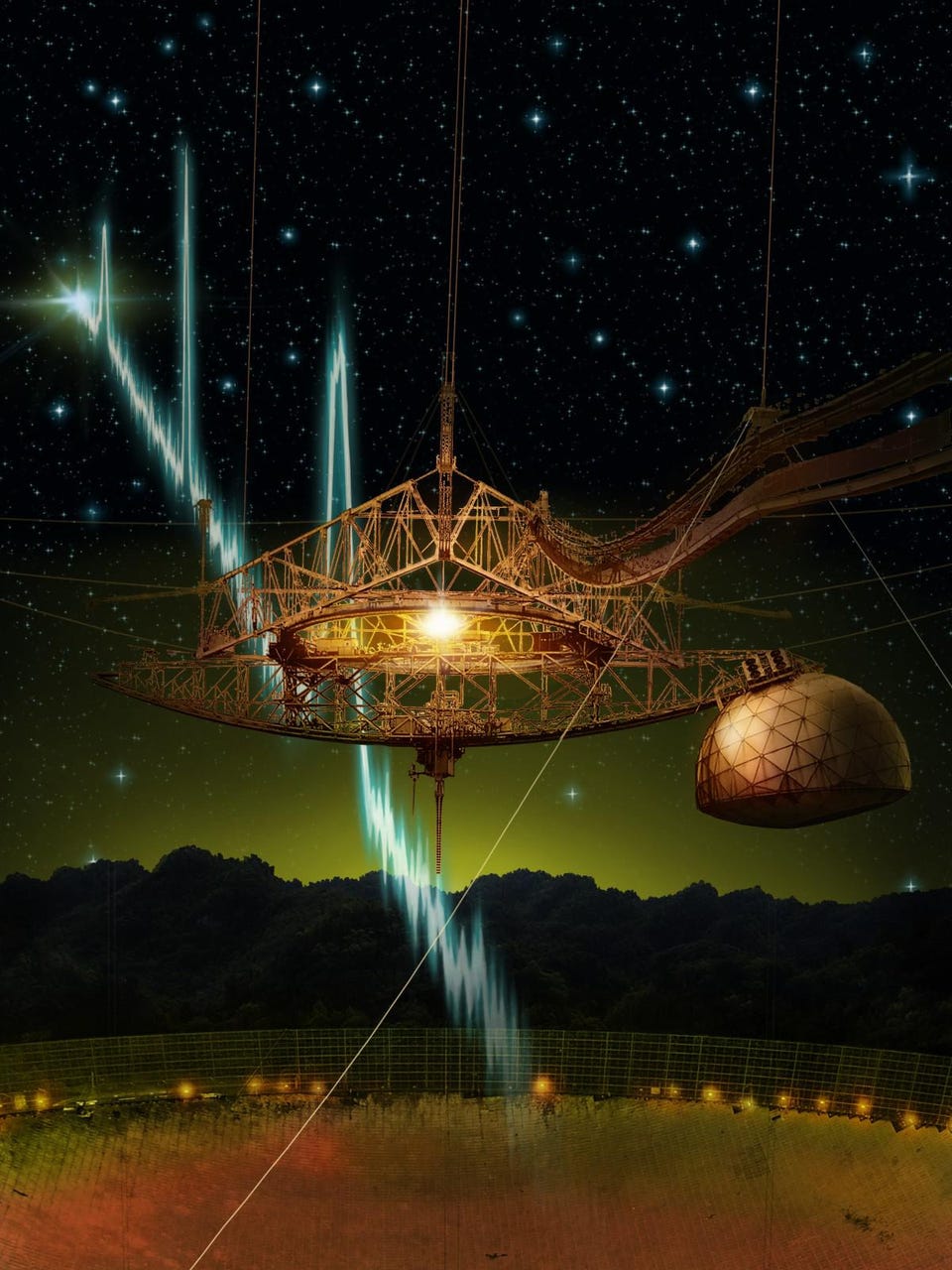
8.) What do you think the chances are that we’ll find intelligent life in the Milky Way?
This is a very hard question. It’s not hard because I don’t think there are inhabited worlds with intelligent organisms living on it within the Milky Way; I think there very likely are. I think it’s a hard question because we are incredibly bad, despite our vast intelligence as humans, in recognizing intelligence in other organisms that we have right here on Earth. It might be easy to recognize a Chimpanzee as somewhat intelligent, because its intelligence appears similar to our own in many ways. But as you go to more and more foreign organisms:
- elephants,
- dolphins,
- crows,
- and octopi,
we have to become more and more sophisticated in our recognition of what intelligence can look like in ways that manifest differently from our own.
I think it’s extremely likely that intelligent life is out there, but it’s going to be very difficult to detect it anytime soon because we won’t know what specific signs of intelligence we should be looking for when we encounter it. We would do well to remember Carl Sagan’s wise words: that “absence of evidence is not evidence of absence,” especially when we only know a specific subset of evidence to look for as far as finding “intelligence” is concerned. I’m much more concerned that we’ll see it, overlook it, and wrongly conclude that it isn’t there.

9.) If you had a more stable environment than Earth, would it be more or less likely that life would evolve into intelligent beings?
As with most things, there’s going to be a “sweet spot” when it comes to stability versus instability. If your environment is very stable — if there’s no disequilibrium — then there’s no way for life to form in the first place. Being out-of-equilibrium, and having chemical and/or energy gradients, is required to give rise to life. Later on, having very stable conditions, where organisms can thrive without changing what they’re doing or how they’re doing it, similarly leads to things remaining the same. The koala, the least intelligent mammal on the planet, has hardly changed at all in 55 million years because eucalyptus leaves have remained abundant, and there’s no competition for them because no other animal can digest them.
On the other hand, if there’s too much disequilibrium, or too much instability, then extinction becomes the rule, not the exception. Here on Earth, we have long periods of stability punctuated by short periods of major instability: mass extinction events. Having mass extinction events where 100% of living organisms don’t go extinct is important for evolution; if the dinosaurs had never gone extinct, humans wouldn’t have arisen. But would intelligent life be more favorable on a world with more instability than Earth? With more stability than Earth? Without not just a second example of life in the Universe, but many examples, we cannot know. After all, Earth is the only successful cosmic experiment we know of where intelligent life is the result.

10.) If organic life evolves technically similar to us, isn’t it likely that artificial general intelligence (AGI) is the final outcome? And if so, isn’t the fact that nobody has contacted us evidence that we are, if not alone in our galaxy, the first species to reach this level of technological advancement in our galaxy?
There are certainly a lot of people who think this way today, as it’s an opinion touted by many who see AGI as the ultimate outcome for any sufficiently advanced species. But almost nobody thought this way 5 years ago. They want you to think of what we’re calling “AGI” as Lt. Cmdr. Data from Star Trek: The Next Generation. If today’s AGI were anything like that, we’d be having a very different conversation. But it isn’t. It’s just a way of putting information together that’s only as good as its training data, and the more data LLMs themselves generate, the worse they get.
No, I don’t think it’s likely that AGI is the final outcome of organic life universally, and I would argue that we should work against that being the final outcome of organic life here on Earth.
Instead, I would argue that variety and diversity aren’t just the “spice of life” for humanity, but are the most interesting things that the broader Universe will have to offer as far as life, and intelligent life, is concerned. AGI should never be treated as the goal of organic life, but rather as a tool to help us achieve our goals: as a species and as a civilization. The absence of ubiquitous, obvious AGI broadcasting signals in our galaxy shouldn’t be taken as evidence against other intelligent civilizations. Rather, our perspectives on it should make us question, if we’re truly this unwise, whether we qualify as an intelligent species at all?

The Power of Play