What is Big Think?  

We are Big Idea Hunters…

We live in a time of information abundance, which far too many of us see as information overload. With the sum total of human knowledge, past and present, at our fingertips, we’re faced with a crisis of attention: which ideas should we engage with, and why? Big Think is an evolving roadmap to the best thinking on the planet — the ideas that can help you think flexibly and act decisively in a multivariate world.

A word about Big Ideas and Themes — The architecture of Big Think

Big ideas are lenses for envisioning the future. Every article and video on bigthink.com and on our learning platforms is based on an emerging “big idea” that is significant, widely relevant, and actionable. We’re sifting the noise for the questions and insights that have the power to change all of our lives, for decades to come. For example, reverse-engineering is a big idea in that the concept is increasingly useful across multiple disciplines, from education to nanotechnology.

Themes are the seven broad umbrellas under which we organize the hundreds of big ideas that populate Big Think. They include New World Order, Earth and Beyond, 21st Century Living, Going Mental, Extreme Biology, Power and Influence, and Inventing the Future.

Big Think Features:

12,000+ Expert Videos

1

Browse videos featuring experts across a wide range of disciplines, from personal health to business leadership to neuroscience.

Watch videos

World Renowned Bloggers

2

Big Think’s contributors offer expert analysis of the big ideas behind the news.

Go to blogs

Big Think Edge

3

Big Think’s Edge learning platform for career mentorship and professional development provides engaging and actionable courses delivered by the people who are shaping our future.

Find out more
Close

Can We Automate Creativity?
July 29, 2012, 1:15 PM
Robot%20musician%20ss

What's the Latest Development?

In 2004, New Zealander Ben Novak went from being a musical unknown with no industry connections to a top-10 hit across European radio stations. Rather than owing his lucky break to a talent scout, Novak had a computer algorithm to thank. Created by the company Music X-Ray, the software "uses Fourier transforms—a method of separating a signal from the 'noise' of complex data—to isolate a song's base melody, beat, tempo, rhythm, octave, pitch, chords, progression, sonic brilliance, and several other factors that catch a listener's ear." By building a 3D model of these qualities, the software can compare new songs to hits of the past. 

What's the Big Idea?

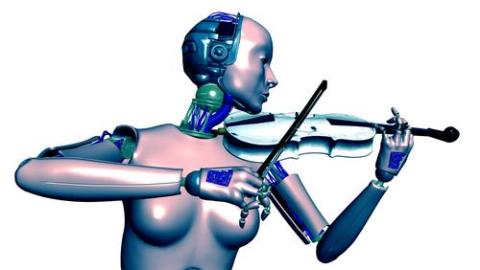
While machines may be able to recognize what kind of music humans like, will they ever create original compositions that suit our taste? David Cope, a professor emeritus at UC Santa Cruz, believes they will. By weaving thousands of lines of LISP code into music making algorithms, Cope has produced classical music "that imitates masters like Johann Sebastian Bach so well that people can't always tell the difference. ... Cope's latest algorithm, which he's dubbed Annie, takes programmed creativity yet a step further. She decides on the musical patterns, the criteria, and ultimately, the path she takes to making music."

Photo credit: Shutterstock.com


Can We Automate Creativity?

Newsletter: Share: