What is Big Think?  

We are Big Idea Hunters…

We live in a time of information abundance, which far too many of us see as information overload. With the sum total of human knowledge, past and present, at our fingertips, we’re faced with a crisis of attention: which ideas should we engage with, and why? Big Think is an evolving roadmap to the best thinking on the planet — the ideas that can help you think flexibly and act decisively in a multivariate world.

A word about Big Ideas and Themes — The architecture of Big Think

Big ideas are lenses for envisioning the future. Every article and video on bigthink.com and on our learning platforms is based on an emerging “big idea” that is significant, widely relevant, and actionable. We’re sifting the noise for the questions and insights that have the power to change all of our lives, for decades to come. For example, reverse-engineering is a big idea in that the concept is increasingly useful across multiple disciplines, from education to nanotechnology.

Themes are the seven broad umbrellas under which we organize the hundreds of big ideas that populate Big Think. They include New World Order, Earth and Beyond, 21st Century Living, Going Mental, Extreme Biology, Power and Influence, and Inventing the Future.

Big Think Features:

12,000+ Expert Videos

1

Browse videos featuring experts across a wide range of disciplines, from personal health to business leadership to neuroscience.

Watch videos

World Renowned Bloggers

2

Big Think’s contributors offer expert analysis of the big ideas behind the news.

Go to blogs

Big Think Edge

3

Big Think’s Edge learning platform for career mentorship and professional development provides engaging and actionable courses delivered by the people who are shaping our future.

Find out more
Close

A Screenplay Guru on the Importance of Craft
April 19, 2010, 12:00 AM
2406045813_cab5f8211d
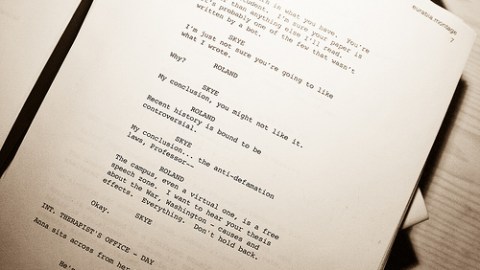
Many an aspiring screenwriter has pored over Robert McKee's book "Story: Substance, Structure, Style and The Principles of Screenwriting," trying to suss out the creative secrets that will result in their words ending up on the silver screen. In his Big Think interview, the creator of the "Story Seminar" says that all good storytelling is about conflict, and that  the level of conflict a writer is interested in should determine the medium he writes for. He says that stories play a vital part in our lives, perhaps now more than ever—and the job of the writer to make sense out of the chaos in the world around us.

McKee himself hasn't had a feature film produced (though he's had 12 scripts optioned, some several times over), but his students have gone on to win 32 Academy Awards and 158 Emmy Awards.  He says it's impossible to teach people "how" to write, so instead he aims to instill the idea of a writer's craft in his students—raising the right questions instead of giving answers, and teaching them to produce work that is original rather than just following the latest Hollywood trends. And he says the most destructive screenwriting advice a teacher can give is to tell a writer that certain plot points need to happen on particular pages.

In Charlie Kaufman's film "Adaptation," McKee himself was a character—a blustery screenwriting guru who chews out the main character for wanting to write a film where nothing happens. McKee says he was initially wary of being portrayed in the film, but that he eventually "loved" seeing himself in the final product.

He also thinks that aspiring executives and politicians could benefit from learning how to write a screenplay. Business is all about persuasion, says McKee, and the best way to persuade someone is to put your pitch in the context of a story.


 

A Screenplay Guru on the Im...

Newsletter: Share: