U.S. Treasury Secretary Timothy Geithner: Fireman, Doctor, Bomb Diffuser
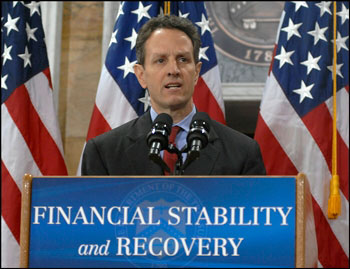
Tim Geithner probably did more to define himself today during the Sunday political talk show This Week than he has since he was appointed Secretary of the Treasury by the Obama administration. When Jake Tapper asked him whether the turmoil in the nation’s financial sector had been “personally nerve wracking,” Geithner allowed a half smile and said “this job — these jobs are a little bit like the fireman. They’re a little bit like the doctor. And they’re a little bit like the people that go and try to diffuse bombs.”
TV political talk shows are typically pretty topical, given their time constraints. And Jake Tapper, the current fill-in host of This Week, has a long way to go before he can command the issues well enough to elicit more than the political talking points his guests are ready to regurgitate before he has even finished asking them the question. But Tapper can pat himself on the back this week – he got the notoriously private Tim Geithner to talk a little bit about his state of mind during the past year.
Republicans and progressive Democrats have been calling for Geithner’s head for months. He and Larry Summers, Director of the National Economic Council, are two of the least popular political appointees in the Obama administration. Recruited from his post as president of the New York Fed, Timothy Geithner was pushed into the spotlight immediately — he had to present the White House’s financial system rescue package practically as soon as he walked in the door.
A man who seems to be more comfortable in intimate settings and controlled environments, Geithner was fresh meat for political pundits and political enemies. Both groups relished the idea of taking down anyone even remotely connected with New York money center banks whose irresponsible investment activities appeared to be the catalyst behind our current financial malaise.
Many in the press or the political arena have little knowledge of the intricate relationships that underpin practically all of our country’s financial markets. And even less of the general public, especially those who have been the most vocal lately about the bank bailouts, understand how little power Washington has to actually take over an industry, or how much damage one or two mega investment bank can do to our economy in a couple of days if they totally collapse.
As president of the New York Fed, Geithner was a hands-on player in the Bear Stearns-J.P. Morgan acquisition. He has previously served in the Treasury department under Larry Summers in years past, as well as the International Monetary Fund during the beginning of the Bush administration. He has a unique perspective on the world, spending his youth in Japan, New Delhi, and Bangkok. In many ways, he appears to be a big picture thinker like his boss.
It looks like the financial fire that has threatened our economy for the past two years has been put out. From where I sit, it is hard to say whether the potential threats to the marketplace posed by our banking industry have all been diffused — only time will tell.
Now Timothy Geithner needs to keep his white jacket on and continue nursing our economy back to health.