President Obama Needs Chief Synonym Selector
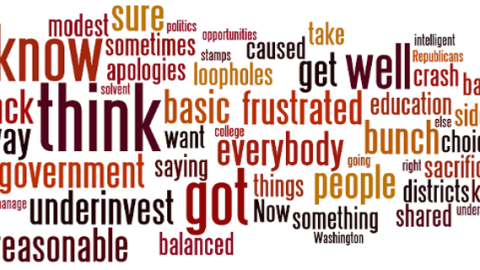
I can’t lie. Every polysyllabic word like “maximalist” that President Obama uttered on his Ground Force One tour this week grated on my nerves. And yet, despite using the type of language that threatens to drown out his message by its very complexity, President Obama is slowly but surely doing what he does best—explaining to the American people in no uncertain terms why he needs their help in order to put some more “bully” in the presidential bully pulpit.
After watching most of the Iowa town hall President Obama held Monday, I will agree with him—there is nothing wrong with being reasonable. But there is something wrong with using the word “reasonable” to describe your own practical nature. President Obama’s rhetoric is pretty predictable these days, maybe he needs to give his speechwriter a six month sabbatical and install a Chief Synonym Selector. They would be in charge of shrinking big adjectives into small adverbs and replacing bland nouns with viscerally potent idioms. Words like “irresponsible” and “inappropriate” are the kind of non-specific euphemisms a fifth grade teacher uses at parent teacher conferences to explain why she had to send Johnny to the principal’s office after he set the trash can on fire.
We are not arguing that Obama always speaks in abstractions, or that he does so more than other politicians or leaders. But we think these recent statements illustrate an aspect of his public speech that can cause problems for him. The reason lies in how our minds and brains process information. Concrete and abstract words activate different parts of the cerebral cortex. Concrete words like hammer, hit and hard are processed more by areas at the back of the brain that handle visual and spatial information. Abstract words like justice, fairly and render activate the frontal lobes, which process information independent of any particular sense (vision, hearing, touch).
The frontal lobes typically are involved when a cognitive process requires effort and attention, which implies that we have an easier time interpreting the meaning of concrete words than interpreting abstract ones. We also have an easier time remembering concrete words because they can be stored in memory using two separate codes: a verbal code (the sounds or characters of the word) and a pictorial code. Abstract words don’t call a specific, universal image to mind. And, concrete words evoke stronger emotional responses, further strengthening our memory for them.
Driven to abstraction: Why Obama’s words are not reaching us
If I were the Chief Synonym Selector, I would build a word bank, the same way I do now when I want to relentlessly drive home a point, by listing the synonyms of a word like “irresponsible, then listing the synonyms of the synonyms, over and over, until the words I began with started to show back up. The word “irresponsible” is directly related to “lazy”, “foolish”, “ridiculous”, “careless”, “wrong”, “strange”, and “weird” – all words that frankly speak to the sensibilities of the average American. If you are going to rhetorically pin the tail on the elephant, Mr. President, you need to use the sharpest words you can find.
The president could have been on vacation since last week, reading the Stieg Larsson trilogy and doting on his daughters. Instead, he went from city to city in that part of America that seems to get an outsized amount of attention from politicians during an election year. He patiently explained to groups of citizens in Iowa and Minnesota and Illinois why we are in the predicament we find ourselves in today as a nation. He described, in stark detail that one can only appreciate by reading the actual transcripts of these gatherings, what it will take to give this country a chance to get its economy back on track.
President Obama has mastered walking softly. If he plans to stay in the White House, it’s time for him to start carrying a big stick.
Illustration created by Wordle from excerpts of President Obama during his bus tour