Is This the Greatest Mother’s Day Portrait Ever?
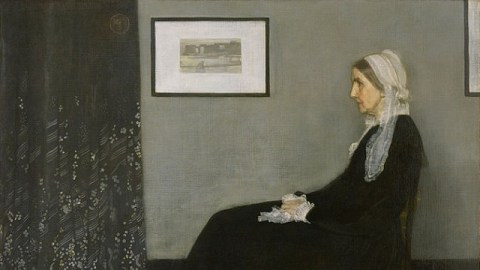
On the one day that we think the most about mothers, grandmothers, godmothers, and all other motherly types, it seems appropriate to ask what is the greatest Mother’s Day portrait ever? The first suspect that lines up in the mind is probably James McNeill Whistler’s 1871 painting Arrangement in Grey and Black No.1, better known as Whistler’s Mother (detail shown above). But the most obvious answer isn’t always the best one, assuming that there is such a thing as a “best.” Looking at how artists have pictured motherhood for us says a lot about them and almost as much about us.
As much as Whistler’s Mother stands as a landmark painting, one of the “must sees” at the Musée d’Orsay and one of the few Americans invading that Parisian paradise, it leaves me cold. That coldness seems intentional, starting with the title. Calling your Mom an “arrangement” isn’t the warmest of sentiments. I know that Whistler loved to call everything a “nocturne,” “harmony,” or “symphony,” including his mistress Joanna Hiffernan (in Symphony in White, No. 1: The White Girl), but somehow reducing the mother that raised you to an arrangement—the status of a bowl of fruit in a still life—seems beyond the pale.
Instead of Whistler and his chilly, black and white Mother’s Day card, I’d like to nominate two other artists, also Americans and also featured in the collection of the Musée d’Orsay: Cecilia Beaux and Mary Cassatt. Both women never married and never had children, but were, of course, daughters themselves and closely observed the nature of motherhood itself.
Although Beaux is less known today than Cassatt, during her lifetime she was considered a premier society portraitist. William Merritt Chase believed her to be “not only the greatest living woman painter, but the best that has ever lived.” Beaux made her name and fortune with society portraits, but she often focused on the nature of mothers and children. Two paintings by Beaux (both of which can be seen here) show just how deeply she pondered the nature of motherhood. In The Last Days of Infancy, the work that brought Beaux her earliest fame, shows Cecilia’s sister Etta with Cecilia’s first-born nephew Harry at three years of age. It’s a fascinating look at that transitional moment when the baby becomes a full-fledged child with a personality and independent spirit—a bittersweet moment for mothers who cherish the intimacy of tending for a baby but also the interaction with the emerging person. In another painting, titled Mother and Daughter, Beaux painted a dual portrait of Mrs. Clement Acton Griscom and her daughter Frances bedecked in the furs and finery of the upper crust. The two women look in different directions and are physically and psychically disconnected. It’s a different view of motherhood—a negative one based on neglect rather than the warm fuzzies normally associated with mothers and daughters. It’s not a great sentiment for Mother’s Day, but it’s another perceptive, vibrant analysis of what it is to be (or not be) a Mom.
If you didn’t think of Whistler at the beginning of this post, you probably thought of Mary Cassatt. Cassatt painted scenes of mothers and children interacting in the most intimate ways, especially somewhere in the vicinity of the bath. The eroticism of some of the scenes makes them less than squeaky clean, but that passion really gets at the heart of motherhood. Getting through the everyday grind of being a Mom requires an underlying passion that never ends. As my Supermom wife likes to say, “The days are long, but the years are short.” For all the long days of baths and books read, Moms make the years more beautiful and memorable for all the love they give. Happy Mother’s Day!
[Image:James McNeill Whistler. Arrangement in Grey and Black No.1, also known as Whistler’s Mother (detail), 1871.]