What is Big Think?  

We are Big Idea Hunters…

We live in a time of information abundance, which far too many of us see as information overload. With the sum total of human knowledge, past and present, at our fingertips, we’re faced with a crisis of attention: which ideas should we engage with, and why? Big Think is an evolving roadmap to the best thinking on the planet — the ideas that can help you think flexibly and act decisively in a multivariate world.

A word about Big Ideas and Themes — The architecture of Big Think

Big ideas are lenses for envisioning the future. Every article and video on bigthink.com and on our learning platforms is based on an emerging “big idea” that is significant, widely relevant, and actionable. We’re sifting the noise for the questions and insights that have the power to change all of our lives, for decades to come. For example, reverse-engineering is a big idea in that the concept is increasingly useful across multiple disciplines, from education to nanotechnology.

Themes are the seven broad umbrellas under which we organize the hundreds of big ideas that populate Big Think. They include New World Order, Earth and Beyond, 21st Century Living, Going Mental, Extreme Biology, Power and Influence, and Inventing the Future.

Big Think Features:

12,000+ Expert Videos

1

Browse videos featuring experts across a wide range of disciplines, from personal health to business leadership to neuroscience.

Watch videos

World Renowned Bloggers

2

Big Think’s contributors offer expert analysis of the big ideas behind the news.

Go to blogs

Big Think Edge

3

Big Think’s Edge learning platform for career mentorship and professional development provides engaging and actionable courses delivered by the people who are shaping our future.

Find out more
Close

Supersymmetry: Physics Could Get Weird After a Higgs Discovery
July 3, 2012, 11:15 AM
Higgs%20new%20wc

What's the Latest Development?

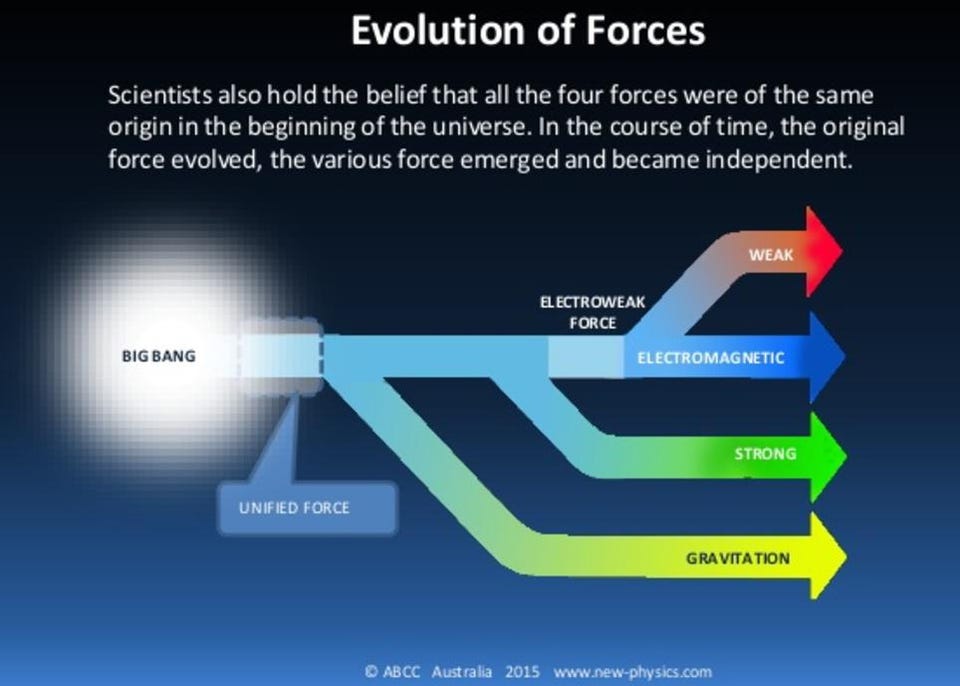
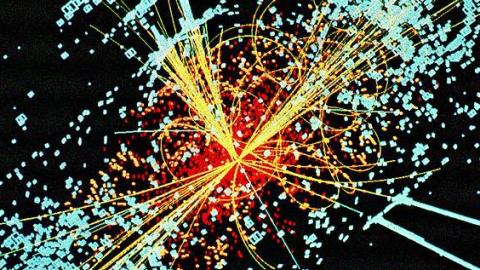
As physicists await the Wednesday announcement from Europe's CERN laboratory concerning the possible discovery of the Higgs particle, some are pondering what our vision of the Universe will look like if the Higgs is confirmed. Theoretical physicist Lawrence Krauss believes that even if the mass of the Higgs particle is discovered, important questions remain about the Standard Model, the framework that physicists use to describe the behavior of all known subatomic particles and fundamental forces. One lingering question is why the four known forces—gravity, electromagnetism, the weak force, and the strong force—have such differing values. One proposed solution is known as supersymmetry. 

What's the Big Idea?

Supersymmetry is popular because it prevents an apparent inconsistency from appearing in the weak force, namely that the constant jiggling of quantum particles should push the strength of the weak force away from its observed value. However, the Large Hadron Collider, which is working to discover the Higgs particle, has found no experimental evidence of the superpartner particles required by sypersymmetry. But if evidence for supersymmetry is not found, where does that leave particle physics? "We don’t know," said Krauss. "The likelihood that we will build another large particle accelerator in our lifetime is not good. So, if this is it, then we’re in a real quandary."

Photo credit: Shutterstock.com


Supersymmetry: Physics Coul...

Newsletter: Share: