What is Big Think?  

We are Big Idea Hunters…

We live in a time of information abundance, which far too many of us see as information overload. With the sum total of human knowledge, past and present, at our fingertips, we’re faced with a crisis of attention: which ideas should we engage with, and why? Big Think is an evolving roadmap to the best thinking on the planet — the ideas that can help you think flexibly and act decisively in a multivariate world.

A word about Big Ideas and Themes — The architecture of Big Think

Big ideas are lenses for envisioning the future. Every article and video on bigthink.com and on our learning platforms is based on an emerging “big idea” that is significant, widely relevant, and actionable. We’re sifting the noise for the questions and insights that have the power to change all of our lives, for decades to come. For example, reverse-engineering is a big idea in that the concept is increasingly useful across multiple disciplines, from education to nanotechnology.

Themes are the seven broad umbrellas under which we organize the hundreds of big ideas that populate Big Think. They include New World Order, Earth and Beyond, 21st Century Living, Going Mental, Extreme Biology, Power and Influence, and Inventing the Future.

Big Think Features:

12,000+ Expert Videos

1

Browse videos featuring experts across a wide range of disciplines, from personal health to business leadership to neuroscience.

Watch videos

World Renowned Bloggers

2

Big Think’s contributors offer expert analysis of the big ideas behind the news.

Go to blogs

Big Think Edge

3

Big Think’s Edge learning platform for career mentorship and professional development provides engaging and actionable courses delivered by the people who are shaping our future.

Find out more
Close

How Scientists Will Use the Transit of Venus to Find Alien Worlds
June 6, 2012, 7:30 AM
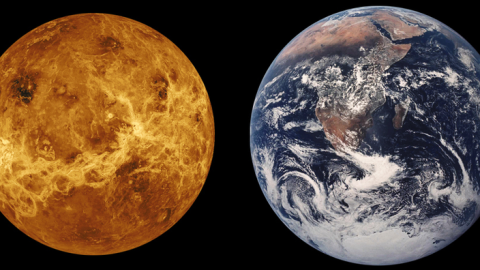
Venus%20earth%20ss

What's the Latest Development?

For the National Solar Observatory, yesterday's transit of Venus was an opportunity to do cutting edge science that will help in finding and analyzing alien worlds. Telescopes in Arizona, New Mexico, California, Hawaii, Australia and India took measurements of the planet's thick, carbon-dioxide-rich atmosphere as light refracted against it. "Because the composition of Venus' air is relatively well known, such observations should provide a benchmark for studying details of exoplanet atmospheres during transits." Astronomers can use transits to detect foreign planets because they cause a dip in the brightness of their parent star. 

What's the Big Idea?

The transit of Venus, which occurs in pairs separated by more than a century, has been used by scientists to study the day's important astronomical questions. "For example, scientists mounted huge expeditions to view the 18th century's two transits, which occurred in 1761 and 1769. The goal was to time the transit precisely from many different points around the globe, then calculate the Earth-sun distance using the principles of parallax. With this information in hand, the scale of the entire solar system would follow." While those expeditions failed, scientists got the data they wanted in the transits of 1874 and 1882. 

Photo credit: Shutterstock.com


How Scientists Will Use the...

Newsletter: Share: