What is Big Think?  

We are Big Idea Hunters…

We live in a time of information abundance, which far too many of us see as information overload. With the sum total of human knowledge, past and present, at our fingertips, we’re faced with a crisis of attention: which ideas should we engage with, and why? Big Think is an evolving roadmap to the best thinking on the planet — the ideas that can help you think flexibly and act decisively in a multivariate world.

A word about Big Ideas and Themes — The architecture of Big Think

Big ideas are lenses for envisioning the future. Every article and video on bigthink.com and on our learning platforms is based on an emerging “big idea” that is significant, widely relevant, and actionable. We’re sifting the noise for the questions and insights that have the power to change all of our lives, for decades to come. For example, reverse-engineering is a big idea in that the concept is increasingly useful across multiple disciplines, from education to nanotechnology.

Themes are the seven broad umbrellas under which we organize the hundreds of big ideas that populate Big Think. They include New World Order, Earth and Beyond, 21st Century Living, Going Mental, Extreme Biology, Power and Influence, and Inventing the Future.

Big Think Features:

12,000+ Expert Videos

1

Browse videos featuring experts across a wide range of disciplines, from personal health to business leadership to neuroscience.

Watch videos

World Renowned Bloggers

2

Big Think’s contributors offer expert analysis of the big ideas behind the news.

Go to blogs

Big Think Edge

3

Big Think’s Edge learning platform for career mentorship and professional development provides engaging and actionable courses delivered by the people who are shaping our future.

Find out more
Close

4 Trillion Degrees: New Man-Made Temperature Record Set by US Lab
June 28, 2012, 7:30 AM
Hot%20hot%20heat%20ss

What's the Latest Development?

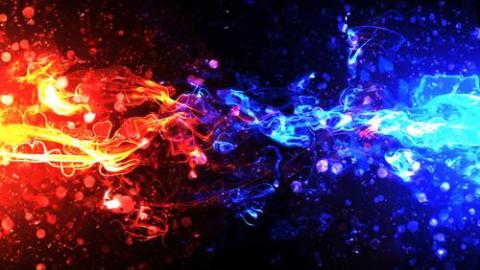
Scientists at the Brookhaven National Laboratory in New York have created the highest-ever man-made temperature, slamming atoms of gold together at near-light speed to create a blast measured at four trillion degrees Celsius--250,000 times hotter than the sun's core. The collision resulted in impact energy so intense that "the neutrons and protons inside the gold nuclei 'melted,' releasing fundamental quarks and gluons that then formed a nearly friction-free primordial plasma." Scientists believe this plasma existed only one-millionth of a second immediately after the Big Bang occurred. 

What's the Big Idea?

Curiously, the physical state of "friction-free primordial plasma," which was observed as a result of the super-hot collision, has been seen at temperatures approaching absolute zero--ten million trillion times colder than quark-gluon plasma. "This is just one among many unexpected connections we've found between [our laboratory's] physics and other scientific forefronts," said Brookhaven physicist Steven Vigdor. "The unity of physics is a beautiful thing!" Europe's Large Hadron Collider, which is capable of producing 30% higher temperature levels, is expected to release new energy data soon. 

Photo credit: Shutterstock.com



4 Trillion Degrees: New Man...

Newsletter: Share: