Regulators Let BP Skip Required Permits
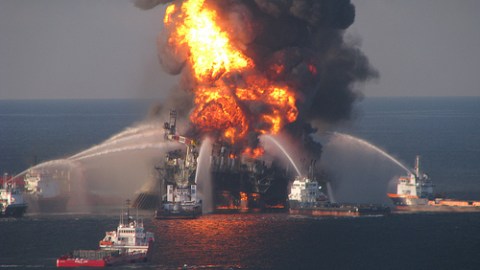
Federal regulators apparently allowed BP and dozens of other oil companies to begin drilling without obtaining mandatory environmental permits, according to the New York Times. By law, the Minerals Management Service (MMS) needs to get the OK of the National Oceanic and Atmospheric Administration (NOAA) before allowing drilling that might harm endangered species and/or marine mammals. Clearly, the Deepwater Horizon was that sort of project. AP reporters have already seen dolphins playing in oily water. Yet the rig got the go ahead without an NOAA permit.
MMS insists that it consulted with NOAA before greenlighting these drilling operations, including the Deepwater Horizon. The New York Times backs MMS up on that point. There were “consultations” during which NOAA said that MMS needed permits and MMS ignored NOA.
“Federal records indicate that these consultations ended with NOAA instructing the minerals agency that continued drilling in the gulf was harming endangered marine mammals and that the agency needed to get permits to be in compliance with federal law.” [NYT]
President Obama campaigned on a promise to restore science to its rightful place in government, but the Times investigation found that this lofty goal had not permeated MMS where scientists said they are bullied and censored into ignoring inconvenient truths:
“You simply are not allowed to conclude that the drilling will have an impact,” said one scientist who has worked for the minerals agency for more than a decade. “If you find the risks of a spill are high or you conclude that a certain species will be affected, your report gets disappeared in a desk drawer and they find another scientist to redo it or they rewrite it for you.” [NYT]
In case you thought the news couldn’t get any worse, NPR obtained underwater footage of the oil geyser and sent it out for an independent assessment. NPR’s experts found that the well is leaking up to 70,000 barrels of oil per day, a far cry from the 5,000 barrels a day figure that has been widely reported. The 70K estimate is accurate to within plus or minus 20%, which means the true rate is probably somewhere between 56,000 and 84,000 barrels a day.
[Photo credit: flickr user Sky Truth, licensed under Creative Commons.]