Are Corporations “People”?
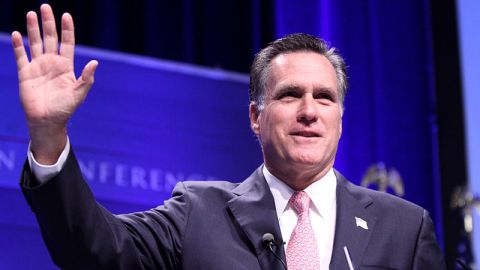
In a heated exchange with hecklers at the Iowa State Fair captured by C-SPAN, Presidential candidate Mitt Romney went head-to-head with voters over corporate tax policy. Romney’s passionate assertion that “Corporations are People” is sure to become one of the buzzwords of the election season if for no other reason that it perfectly captures the current economic zeitgeist. At a time when Washington is caught up in gridlock, when the stock market is supplying more thrills than a roller coaster at an amusement park, the American electorate has found the perfect super-villain – the out-of-touch former corporate executive demanding tax cuts for CEOs flying around the country in their private jets.
From a strictly legal perspective, corporations are, indeed, “people” — they have the right to sign contracts, the right to own property, and the right to free speech. What enraged the hecklers, of course, was not the finer points of corporate law, but rather the raw sentiment that comes when a putatively meritocratic nation has been transformed into a nation of haves and have-nots. The housing crisis finally exposed the unwholesome fact that there has been a hollowing-out of the middle class and a widening chasm between the economic elite and the rest of us. The rent is too damn high, indeed.
In the cover story for the current issue of The Atlantic, Don Peck brilliantly analyzes the transformative effect of the growing wealth gap in America. The top 1% of Americans control as much wealth as the bottom 60% put together. Five years ago, a trio of Citigroup analysts even coined a term to describe America’s economy – plutonomy – economic growth powered by and consumed by a wealthy few. Such an imbalance in wealth is ultimately dangerous, of course. One need only look across the pond to see the impact of economic disenfranchisement on an entire democratic society.
If there’s been one result from this summer’s budget wrangling and debt ceiling fiasco in Washington, it’s that there has been a complete loss of faith in not only government, but also in American-style capitalism. The fires burning in London should be a wake-up call.
So, are corporations “people”? Ultimately, it depends on your views of where the money goes when a corporation turns a profit. If you believe that the money ultimately flows only into the suit pockets of corporate bigwigs, corporations are not “people” — they are merely a legal fiction to mask a confiscation of wealth. If, on the other hand, you believe (like Romney) that profits from corporations flow down to the middle-class worker in the cubicle or the foreman on the factory floor – then corporations are “people.” As a society, we’ve reached a conclusion that corporations are “people” – but only in the sense that members of an Untouchable caste are “people.” Discrimination against them may be technically illegal, but violent reprisals are possible if they forget their place.