Where Does Conservative Political Language Come From?
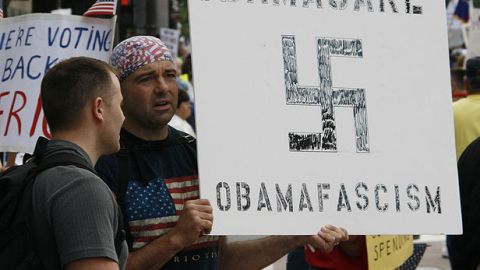
Armageddon. Impeachment. Fascist. Communist. Muslim. Radical. Baby killer. The language of political discourse in America has been reduced to alarming idioms and dramatic phrases. It is the kind of overheated rhetoric that has replaced the ideas and ideals public debate used to revolve around. But where does this come from? And why are we seeing so much of it today from what used to be known as the Grand Old Party?
I was pretty curious myself, so I did some digging around the internet. One of the most plausible explanations for this phenomenon has been advanced by George Lakoff, a UC Berkeley professor of linguistics and cognitive science and co-founder of the Rockbridge Institute. Lakoff is the author of “Moral Politics: How Liberals and Conservatives Think,” first published in 1997 and reissued in 2002. In a long interview with Bonnie Azab Powell, Lakoff spoke candidly about the language of politics.
POWELL: Why do conservatives appear to be so much better at framing the language?
LAKOFF: Because they’ve put billions of dollars into it.
Over the last 30 years their think tanks have made a heavy investment in ideas and in language. In 1970, [Supreme Court Justice] Lewis Powell wrote a fateful memo to the National Chamber of Commerce saying that all of our best students are becoming anti-business because of the Vietnam War, and that we needed to do something about it. Powell’s agenda included getting wealthy conservatives to set up professorships, setting up institutes on and off campus where intellectuals would write books from a conservative business perspective, and setting up think tanks.
He outlined the whole thing in 1970. They set up the Heritage Foundation in 1973, and the Manhattan Institute after that. [There are many others, including the American Enterprise Institute and the Hoover Institute at Stanford, which date from the 1940s.]
And now, as the New York Times Magazine quoted Paul Weyrich, who started the Heritage Foundation, they have 1,500 conservative radio talk show hosts. They have a huge, very good operation, and they understand their own moral system. They understand what unites conservatives, and they understand how to talk about it, and they are constantly updating their research on how best to express their ideas.
Until I’d read this interview by Lakoff, I never really thought about the hundreds of small radio stations across the country that fill the AM dial as “infrastructure.” But they all have a local audience large enough to support their operations, and in many of the locales I’ve driven though around the nation, much of the programming appears to be the talk radio format. It is from this combination of coast to coast radio cheerleaders, think tank position papers whose “findings” are echoed by newspaper columnists, and TV commentators that words like armageddon, fascist, communist, muslim, radical, and babykiller have become the lexicons of the Republican Party and Tea Party activists.