Could Art Vandalism Become the New Terrorism?
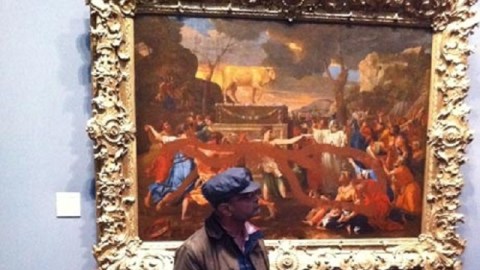
The vandalizing of Nicolas Poussin’s paintings The Adoration of the Golden Calf and Adoration of the Shepherds at the National Gallery of Art in London just this past weekend sent shockwaves through the art world and while setting heads spinning, sent minds thinking. Reactions to the attack include a call for increased security in museums as well as the end of free admission to museums in order to pay for the increased security. Looking at the crimson spray paint crisscrossing Poussin’s painting (shown above), my reaction, after shock and sadness, was to wonder why it was done. Then, with the 10th anniversary of 9/11 looming, I wondered whether art vandalism could become the new terrorism?
I’ve read as much as I could about the attack, but details remain scarce, especially about the attacker. Last Sunday morning in London, a man entered the gallery in which the Poussins were hung and began to spray paint on them until stopped by security. An eye witness claims that the vandal made some statement in French, but wasn’t able to say what that statement was. Conservators rushed to save the works, which are already back on the same walls they graced Sunday morning. The talented staff of the National Gallery managed to erase the visual damage, but the psychic damage may take a little longer.
The usually level-headed Jonathan Jones of The Guardianpressed the huge red panic button in his blog post on the incident. Calling the paintings “sitting ducks” because of the National Gallery’s lax security, which doesn’t even check the bags of patrons as they enter, Jones demanded not only for increased protection, but also a cease to the free entry policy if that increased protection could only be financed by admission charges. “[M]odern society cannot be trusted – there is too much craziness out there. Museums should be more severe on visitors,” Jones misanthropically rails. “No visitor gets into the Louvre without a security scan… Free museums are very fine. But what is the point if people just come in and desecrate the world’s cultural heritage? Charge, search, protect.” Is there really “too much craziness out there” for our cultural treasures to be safe in anything less than a prison environment?
Before decrying the crazy, I think we need to define the crazy first. What motivated this attack? Was it pure schizophrenia, as in the case of Rembrandt’s The Night Watch—victim not once, but twice of vandals who thought figures in the painting spoke to them, which they naturally tried to stop with a knife and acid? That kind of “crazy” (not the politically correct term, of course) might be slowed by security, but I doubt it can be stopped completely. The TSA’s failure rate remains a sore point for all airline patrons, and it’s not like they’re dealing with Lex Luthor-level evil genius daily.
But what if this was “ism”-driven “crazy”? Fundamentalism, radicalism, nationalism—just pick one, but they all can end up in the same destructive certainty that motivates suicide bombers and, perhaps, art vandals. I’m struggling to piece together an “ism” scenario where a Frenchman destroys a French masterpiece on British soil, but that’s pure speculation until more information comes out. Both Poussin paintings dealt with religion, so maybe that’s the attacker’s motivation. Again, we just don’t know.
In a world looking for a grand gesture from the terrorists, the obvious targets seem to be centers of financial, political, or military power. But what if someone decides to attack a center of cultural power? What if the Mona Lisa were bombed tomorrow? Would the world mourn differently than the bombing of the White House?
Poussin seems an unlikely candidate for terrorism, especially the grand gesture variety. To study a Poussin is to enter a state of meditation. Too much thought is the opposite of terror. When T.J. Clark tried to write about 9/11, he adapted a book he had already begun on Poussin and called it The Sight of Death—a fascinating but frustrating “experiment” in art writing. Maybe art is too distant from the mainstream today to be a fitting target. If that’s the case, maybe art, then, is the cure for terrorism—the meditative antidote to the poison of destructive certainty. The conservators of the National Gallery saved the Poussins this time. Perhaps the Poussins, and similar artworks, can save us in return.