Afghanistan and the “Choreography” of Not Getting Laughed At
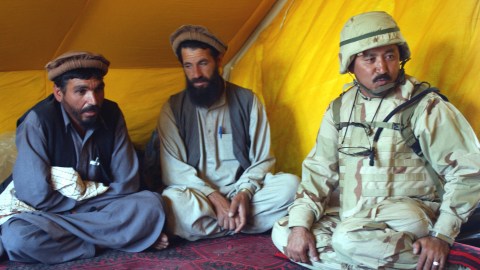
“Obama’s War,” the smart Frontline episode about Afghanistan and Pakistan, includes a disquieting exchange between a U.S. Marine and two tribal elders in a remote Afghan village. Since this Global Pedestrian blog aspires to be about revelatory moments such as these, I can’t stop myself from sharing it here.
In the segment, a Marine sergeant tells a group of villagers, “I need you all to answer my questions. If not, then I’m going to believe right now that the Taliban does come here, they talk to you, you talk to them and you’re still on their side, all right? You need to understand that we are here to keep the Taliban out.”
Then, a translator for the Marines — perhaps because his command of English seems shaky or perhaps because he has his own sense of how the softer side of counterinsurgency is supposed to sound — mellows the Marine’s words in translation: “As you know, we are here to keep the Taliban out. Why are you not helping us?”
A first elder replies, “What can we do?”
The second elder adds, “You have planes, tanks, and guns. We’re simple people with nothing. We don’t even have a sword. If you can’t win, how can we?”
There’s one more detail. As his words trail off and the second elder’s words begin, the first elder chuckles fatalistically.
Later, on the same evening I watched the Frontline episode, I remembered that chuckle as I re-read “Shooting an Elephant,” the essay about George Orwell’s experiences as a cop in colonial Burma. Orwell wrote, “… my whole life, every white man’s life in the East, was one long struggle not to be laughed at.”
A few days later, I came across something else that reminded me of the exchange between the Marine and the elders. It was a YouTube video of a lecture Michael Semple gave at Harvard last month. Semple has worked in Afghanistan for more than two decades. About 39 minutes into his Harvard lecture, Semple summarized advice he’s given to military units preparing for deployments to Afghanistan:
“To be well informed, you have to be able to meet with a wide range of actors. The dynamics of how they will interact with you and what they will say to you depend on who else is in the room. So you have to be able to do choreography so that you show due respect to the people who are formally on top and create opportunities in a way that is non-threatening to them to be able to talk to the other people at another time where they’ll really let their hair down and tell you what’s going on.”
I do not pretend that I’d manage to carry out this “choreography” — especially not with the constant stress of knowing that Taliban bullets might start flying at any moment. We ask so much of our troops.